Glade Restoration Update

Cedars and occasional hardwood trees have been removed from nearly 10 acres of South Fork glade ecosystems at this time….several acres remain for the restoration process. With the heavy tree canopy providing excessive shade above the glade surface, typical flower and grass vegetation is unable to grow.

Eight men have been assisting Tony Millsap and his crew on several different days in the tree removal process of the restoration including one area that is so sensitive with orchid populations that extreme care is needed in keeping excessive activity and machinery out of the area.

Following tree removal, glades will be visibly enhanced with several species of milkweeds (Asclepias) in an attempt to attract monarch butterflies. The US Fish and Wildlife Service is helping fund the restoration and milkweed growing project.

May 2 Docent Training

by Phil Wanz

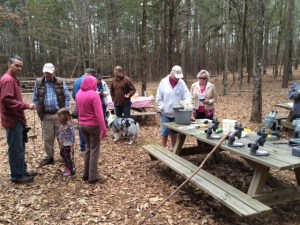
Docent training at South Fork on May 2, 2015 was a day filled with the most pleasant of times. I arrived a tad early, a fire was already blazing and hot coffee on the camp stove. It was a chilly morning and the fire felt good. Blackberry cobbler was cooking in a cast-iron dutch oven, with coals on top to maintain it correct temp, (at least Don hoped so!) The cobbler was superb and I think everyone agreed with me on that.

We started the day with a circle of chairs around the fire. Exciting news was discussed including very cool future plans that sounded fantastic. I will let others tell of these plans as they become set in stone. As usual, I was very impressed with all those who spoke during this session.

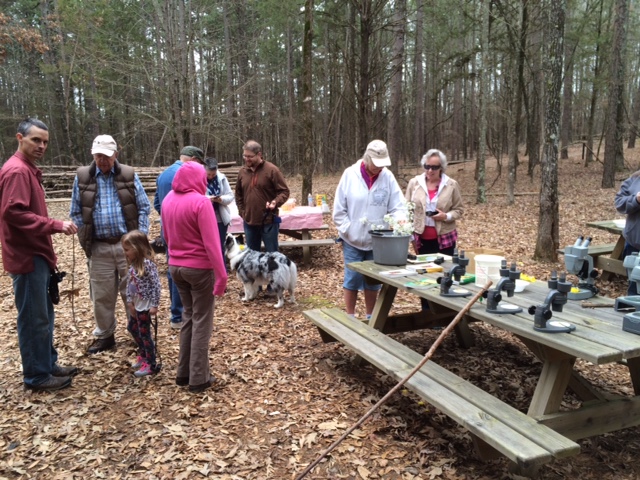
We moved on to the many microscopes set up on the table. Don taught a class on flowers, including the parts of a flower, which was an open discussion, hands-on stuff…it was teaching the teachers so they can go on and teach others. We had fun with the microscopes, at one point it got a bit exciting, “look at this crazy looking bug”… “Wait a minute, no fair,” Don yelled, “this is about flowers, not bugs!” We quickly resumed our flower looking.

Nature Day at South Fork 2015

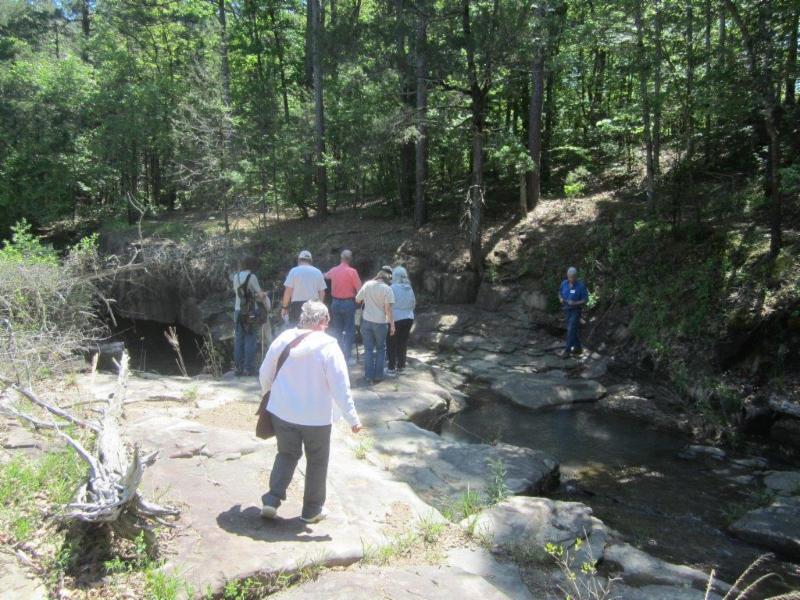
For our next adventure we got on one of South Fork’s many hiking trails for more instruction and some fun. We hiked to the creek and waterfall area, which is so beautiful.

After that it was on to one of the docent’s house for a s u p er lunch and great fellowship. We hiked the short way back to the cabin where we discussed how important it is to journal one’s experiences.

may-docent-training2

I really enjoyed this, thinking to myself that perhaps this is for me. Then we went through all that was in the cabin for future-lead hikes and such. This was a great day, a day for the docents to reform and reboot ideas and thoughts. I urge you to bring your groups, classes, families and yourselves, to our planned activities. If you happen to be a person with training in some particular field, in which our activities exist, you would be welcome to join the group of docents that we have. South Fork is a rewarding place for all those who visit here and leading a hike or tagging along is always a grand time, which is filled with wonderment and education!!

What are you doing for Earth Day?

Janet Miron, South Fork Nature Center-Gates Rogers Foundation - Office of Operations
Janet Miron, Office of Operations
By Janet Miron

April 22nd is Earth Day. Arkansas is gearing up for Earth Day Festivities. Teachers are planning their lessons on environmental awareness and organizations are scheduling clean-up projects. But what is “Earth Day”? How did it start? Does it have a founder? How long have we been celebrating Earth Day? Is it just celebrated in the United States? How do we protect the earth? In this article you will learn about “Earth Day”. You’ll read about its history and objectives. Below, we’ve supplied you with great Earth Day resources to use in the classroom or at home with your families.

The first Earth Day in 1970 put environmental concerns front and center. Earth day founder Gaylord Nelson, a Senator from Wisconsin, was inspired after witnessing the massive 1969 oil spill in Santa Barbara California. Gaylord Nelson was quoted as saying “The ultimate test of man’s conscience may be his willingness to sacrifice something today for future generations whose words of thanks will not be heard.” Earth Day went Global in 1990. It mobilized 200 million people in 141 countries.World-wide recycling efforts were implemented after this mobilization and this paved the way for the 1992 United Nations Earth Summit in Rio de Janeiro. President Bill Clinton awarded Senator Nelson the Presidential Medal of Freedom (1995) for his role as Earth Day Founder.

Earth Day revolves around the theme of “Reduce, Reuse & Recycle”. Community recycle programs, area clean-up days, landfill disposal awareness and the elimination of leaded gasoline were products of the Earth Day environmental movement. Environmental Stewardship is a hot topic in all levels of government and in many educational, social and corporate communities.

Arkansas’s 12th annual Arkansas Earth Day Festival is planned. The Festival’s Theme this year is “Let’s Get Back to Our Roots”. The festival will be held on April 18, 2015 from 11 a.m. – 4 p.m. at Heifer International Grounds in Little Rock, Arkansas. Check their website at Heifer International Website for more details.

April is a great month for teachers and organizations to Contact South Fork Nature Center to schedule a trip to South Fork nature center. Our Docent Staff is ready to make your visit to our facility an educational experience that can be a “hands-on” outdoor extension of traditional, classroom lessons. Visit our Website at https://southforknaturecenter.org/ and click on the education tab for more information on how to schedule a field trip for your class or group.

Links for Earth Day resources:

Five fun Earth Day activities Earth Day Activities

Earth Day 2015 Guides and Programs Earth Day 2015 Guide

March 21 Docent Report

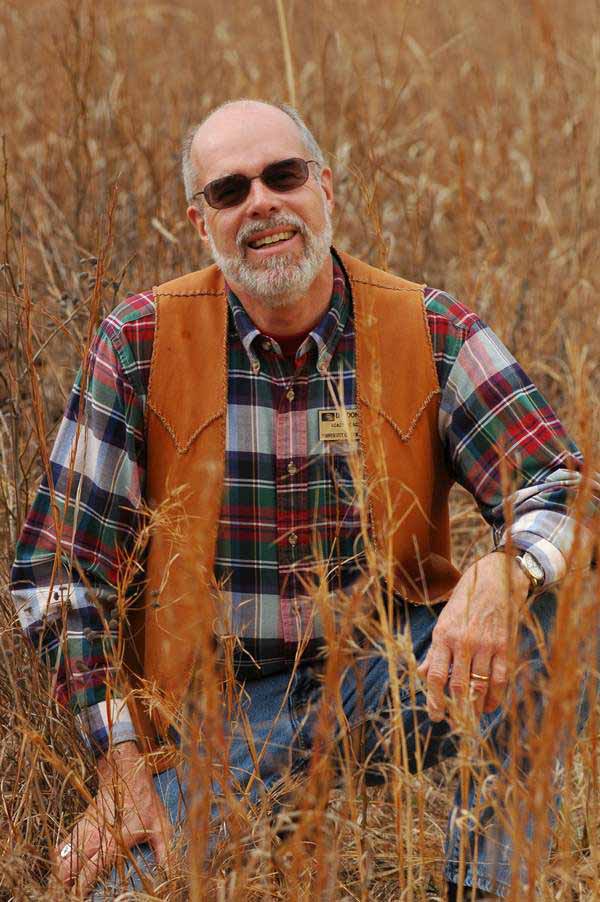
Dr. Don Culwellby Don Culwell

Fifteen folks gathered for peach cobbler on Saturday, March 21, around the coffee pot at the Riddle cabin. The sun peeked out from under the clouds a time or two. We made some new friends and caught up with others. Visiting got us going even before Don Culwell passed out jonquils from the roadside for use in checking out the life cycle of flowering plants. A hand lens helped identify the parts and note their functions: attraction of pollinators enabling sperm cells to reach egg cells (fertilization), embryo development, and seed maturation. Each individual species can grow from seeds and spread so that the population increases in size.
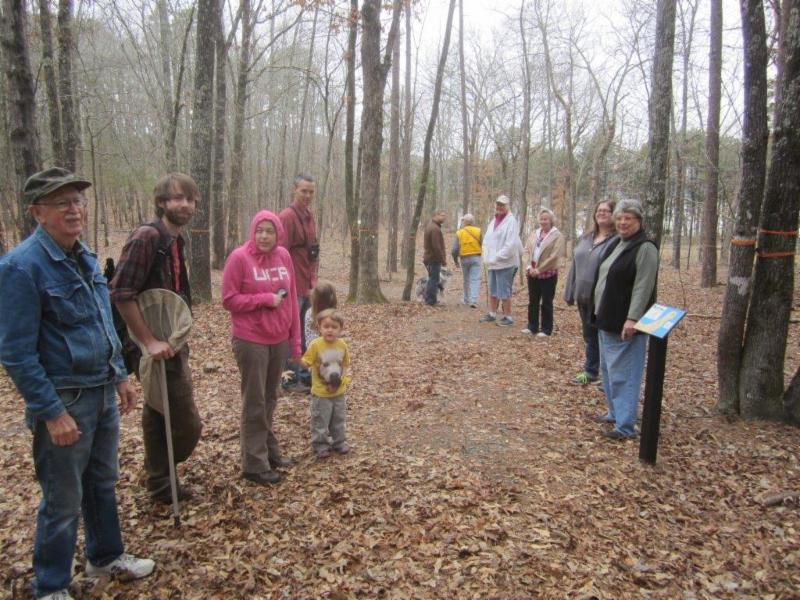
On the Trail South Fork Nature Center March 2015Out on the trail, we checked out all the growth activities of spring. Some of the red buckeye shrubs (Aesculus pavia) still had tight buds and larger ones at the tips of the branches that house the flower buds that will soon produce large Christmas tree-like inflorescences of long red flowers. After breaking open a bud we could see the tight cluster of miniature buds that were yet to begin their spring growth. But many red buckeye buds had already burst, hence throwing off their enlarged colorful bud scales revealing small green palmately compound leaves on a short stem below a cluster of the tight flower buds. Each of these flower buds will have flower parts much like the jonquil that we dissected.
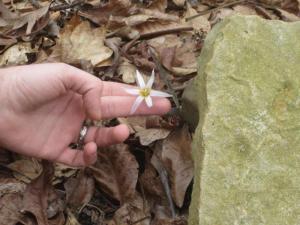
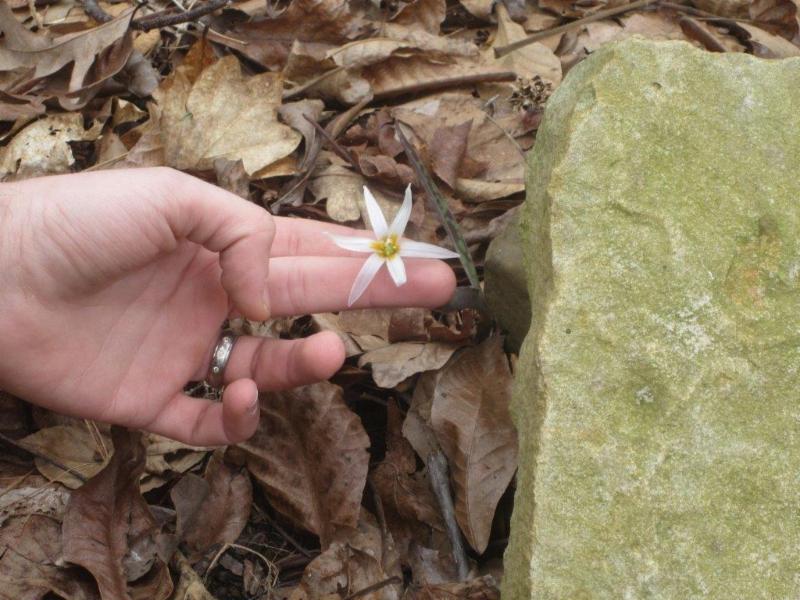
South Fork Nature Walk 2015Wow! Here we see coming up through the fallen oak leaves, the maroon and green mottled leaves of the trout lily (Erythronium albidum) poking their plants through the leaf litter of winter. A single white nodding flower nearly two inches long arose above those mottled leaves. The buds are now visible nearby on leafy toothwort stems (Dentaria laciniata) and will soon burst into their clusters of white flowers.

Lifting pieces of rotting wood along the trail, one could see fungal threads of hyphae, the mycelium of several species of fungi with yellow and some white threads. These threads are the “roots” of the fungus that are already producing enzymes that digest cellulose of the fallen, woody limbs bringing about wood decay and thus nourishment for the fungus. This fungus will push up through the soil producing a mushroom that will make spores later in the spring or summer. Bob Hartmann noted the large variety of fungi which have many colors such as blue, red, orange, yellow, white, and brown. Why do you suppose there are no green ones?
Nature Day at South Fork 2015The pileated woodpeckers of South Fork had been busy throwing out large chunks of wood off the dead oak leaving quarter inch holes where they may have found some insect larval stage of development in some grub-like form.

Jim Solomon picked up several two inch hickory branches all neatly chiseled off from some hickory limb above. He noted how the hickory twig girdler (Oncideres cingulata) had neatly chewed the half inch branch all the way around until it fell. Tiny breaks in the stem beyond the cut revealed where the hickory borer had lain eggs. These eggs will now hatch in the twig on the ground and adults will emerge and mate in the summer. They will then begin to cut more hickory twigs where more eggs will be put into the twig, and the population grows.

Eager hikers continued on the trail, but noon soon arrived. The hand lenses and books were returned to the cabin along with the Coleman stove and coffee pot. good byes were said. The season of South Fork activity had begun and a Saturday morning had been well spent!
Butterfly Release

NATIONAL FISH AND WILDLIFE FOUNDATION and U.S. FISH AND WILDLIFE SERVICE TO THE RESCUE

Butterfly Release 2013

Butterfly Release

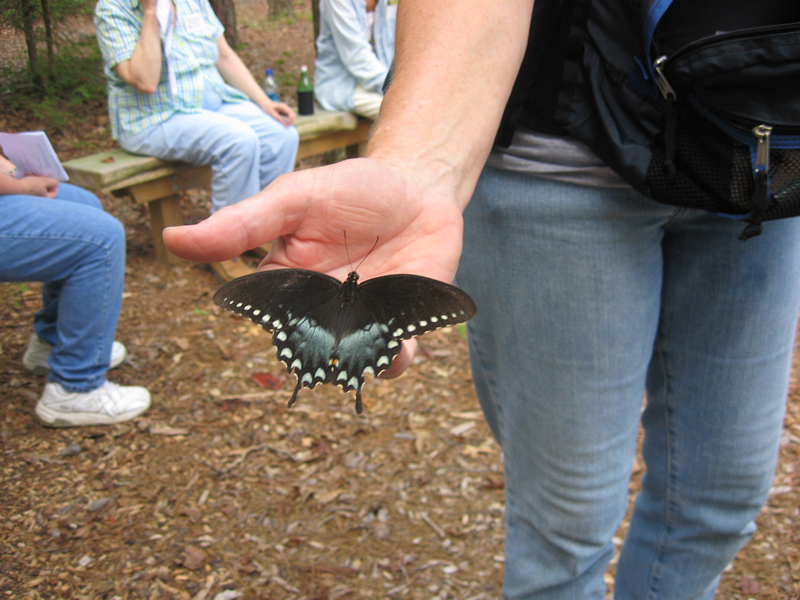
North America’s monarch butterflies spend summers in our back yards, in our open fields of wildflowers, and on our roadsides where natural vegetation of wildflowers grow. Now, come fall, they migrate some 2000 miles to overwinter in some of Mexico’s mountain forests where they cling in masses to each tree limb as if leaves orange and black always grew there. It is these amazing little “flying machines” that are significant pollinators of our plant life, for as they stop to “tank up” on nectar from the flower population, they indeed become major pollinators for the species they visit.

In recent years monarch numbers have plummeted more than 80%, a fact that has caused the Fish and Wildlife Foundation to pledge $1.2 million to foster public and private partnerships in ecosystem restoration where larger numbers of flower species can be visited by monarchs. Their interest comes under concern within the U.S. Endangered Species Act. The U.S. Fish and Wildlife Service has also joined the movement by pledging $2 million to restore and enhance more than 200,000 acres of prime monarch habitat…more than 750 schoolyard habitats and pollinator gardens have become part of this project.

“Their wings are in our hands” as South Fork Nature Center is the recipient of $2000 of this U.S. Fish and Wildlife Service funding for their some 10 acres of glade currently being restored. Mary Ann King of Pine Ridge Gardens north of Russellville is presently growing about 500 milkweed plants from seed, plants that we at South Fork hope to set in to the glade area that is being restored (this glade restoration project is also through USFWS grant monies). Mary Ann says the plants may be ready by early May or so…get your digging tools ready, for the milkweed restoration project is just around the corner. These are the species of Asclepias plants being grown that we will use to enrich our glades for visits by the monarchs: A. incarnata, A. verticillata, A. hirtella, A. amplexicaulis, A. viridis, A. viridiflora.

These milkweed species are the only plants on which monarchs lay their eggs…larvae hatch out and feed exclusively on the milkweed leaves as they grow in size ultimately to pupate and metamorphose into adult monarchs as they emerge from the chrysalis…the adults lay eggs and the cycle begins again. Perhaps programs like this site restoration will allow the monarch population to grow in numbers lifting it from the endangered species list.

(A similar article appears in the 2015 April/May edition of National Wildlife; last month’s SFNC Newsletter also had a related article.)

Nature Center Day

Saturday, April 18, 2015

SFNC March 13, 2012 190Free Programs at South Fork Nature Center! Beginning at 10 a.m. Herbal enthusiast Shirley Pratt for a walk around South Fork Nature Center and learn about some of the Medicinal & Edible Plants of South Fork. The trail walk will emphasize identification and historic uses for plants found in nature. Shirley Pratt, a retired biology teacher and herbal enthusiast, encourages everyone to bring along “mystery plants” for identification! Bring a sack lunch and enjoy the Nature Center for the day!

Joyce HartmannAt 1 p.m. there will be a Sandstone Painting Project led by local artist Joyce Hartmann; she will demonstrate techniques for painting these rocks. You don’t need to be an artist to participate, just willing to learn. All supplies and materials will be furnished, please wear old clothing & something to sit on.

In case of rain, this event will be rescheduled. There will be another rock-painting event May 23rd beginning at 10 a.m. This workshop is free & open to the public

Admission

Please pre-register by calling Joyce at 501-745-6615 or South Fork at 501-745-6444.