Voices in the Night

Voices in The July Night Belong To The Insects

On July 16, 2011, Docents Bob and Joyce Hartmann led a public dusk/night walk to listen to the “Voices of the Night”, braving the 90-100 degree temperatures that had been prevalent for several weeks. However, it was at least ten degrees cooler there in the woods than it was downtown.

We met at dusk at the cabin, where we heard several kinds of cicadas, a Barred Owl, a Yellow-billed Cuckoo, a Northern Cardinal, and people talking and playing music in nearby boats on the lake. As we walked, constantly droning daytime cicada songs gradually gave way to the night sounds of clicking katydids, along with a few crickets. At the first cedar bench circle, we again heard the Barred Owl, and a sudden loud barking warning sound from a Whitetail Deer whose territory we had invaded. The katydids presented their song overpowering concert in full “surround-sound” stereo. It was very relaxing to listen their rhythmical sounds.

Returning the same way we came, we found it quite enjoyable to spend a hot summer evening strolling in the woods along the lake, and recommend the cedar benches as an ideal place to witness a sunset over the lake. And we learned that at the Nature Center, definitely, the Voices of the Night in late July belong to Insects!

Speaking of Insects…
The cicada produces some of the loudest sounds in the insect world. The males “sing” during daylight hours with two ribbed membranes called “tymbals” that click when muscles rapidly contract and release; the two tymbals click alternately. Air sacs in the hollow abdomen amplify the sound, and vibration through the body is also amplified through tympani. Sounds of one insect can be louder than 100 decibels, so imagine the noise produced when a large group sings!

Both male and female katydids, on the other hand, sing at night, producing sound by rubbing their forewings together. There’s a file on one wing and a scraper on the other. The wing membranes and the position they’re held in amplify sounds. The males sing loudly and females chirp in response. They both hear with ears (tympani) on their front legs.


Docent Training

Saturday, June 11, and Friday, June 17, at the Riddle Cabin was the place. Docents, new recruits and old-timers, gathered around the porcelain coffee pot, peach cobbler and earthquake cake to discuss the docent program at SFNC, its effectiveness and its possibilities. Eighteen docents are available to lead activities at SFNC.

Spring at South Fork has been an extraordinary experience for a record number of people: activities on the third Saturday of each month, groups of students from local schools, and walks were requested by several organizations. Forty junior and senior science students of Krissi Graham from Clinton High School were on hand all day for a Saturday experience, thirty students from Julie Nelson’s sixth grade class at South Side spent half a day, and fifteen gifted and talented Clinton students of Chris Box spent a day at the cabin learning as they walked the trails and heard about spinning and weaving cloth. .

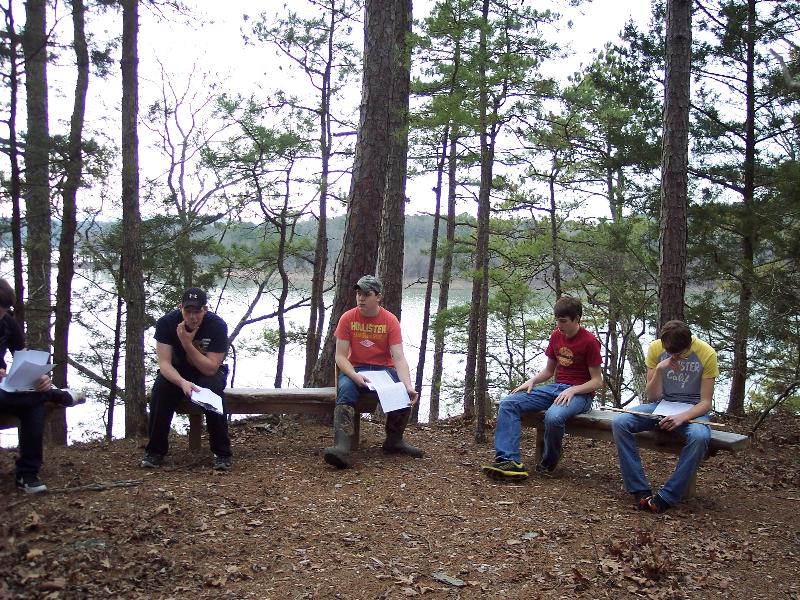
Saturday and Friday’s docent training entailed an assessment of the current program as well as a review of the Docent Handbook noting procedures, plans, and the desired outcome for activities. Experience with hand lenses, microscopes, binoculars, and tree identification keys was gained; a walk taken along the trail noted new trail signs and painted identification stones. Signs gave pictures and text on birds, insects, reptiles and amphibians, plants, the Riddle Cabin, and ecology along the trail. A learning session at the bench circle (outdoor classroom) demonstrated how a group could use the benches for group learning and the appreciation of nature.

In anticipation of walks scheduled for the summer and fall, docents signed up for dates of activity; it is expected that fall school classes from Clinton as well as surrounding schools will take advantage of special outdoor activities planned for their needs during school hours as well as on Saturdays. Contact may be made through the Gates Rogers Foundation office in Clinton by contacting Kathy Sherwood (501-745-6444).

Earth Day 2011

Southside Students
6th Grade students from Southside Bee Branch, Arkansas

Ten docents were on hand to guide students through projects and learning that enhanced their love and appreciation for the out-of-doors “celebrating of nature.”

Earth Day thoughts and discussions were top on their minds as they wrote journal entries and were artistic in designing collages about nature.

Culwell Speaks Internationally

It was in Rotorua, New Zealand, on May 19, 2011, that Don Culwell spoke to a group of about 50 persons in a special community lecture for the University of the Third Age (an international organization for retired persons that exists for the presentation of programs for discussion that involve knowledge, skills, and subjects of interest; www. u3arotorua.com). His presentation was entitled “A Walk in the Woods”where he described the organization, functions, and activities of South Fork Nature Center located at Clinton and The Jewel Moore UCA Nature Reserve located on the campus of the University of Central Arkansas. Also noted were the activities of the Arkansas Native Plant Society that include numerous hikes into natural areas of AR for the enjoyment and education of the participants. These nature centers encourage an understanding of biodiversity and the enjoyment of nature. Kiwis (New Zealanders) were encouraged to enjoy and learn about the biology within their own natural environment taking advantage of their parks, preserves, exceptional landscapes, and ecosystems.

Culwell was in New Zealand with a UCA biology class for the month of May; the class hiked and experienced the ecosystems of both the north and south islands (including the active volcano, White Island, the Franz Josef Glacier, Kiwi preservation parks, lectures on biotechnology for better breeding at the Plant and Food Research Center, tour of a sheep, cattle, and truffle farm, and white water streams).

April 16 Tour

Dr. Don Culwell

A WALK ON THE WILD SIDE

Saturday, April 16…around 11:00 AM, the day at South Fork turned to sunshine from what had been a colder, very breezy morning earlier that day…and it was nice!

Sporting their newly painted stones identifying trees with names as well as leaf, fruit, and twig drawings, the trails had yet another new addition: panoramic signs depicting animal life and plant communities on the peninsula. “Wild Wings” listed birds that could be seen along with their songs, “Creepy Critters’ showed common reptiles and amphibians in the area, “Are You Bugged” pictured insects, “Complex Connections” described aspects of the forest ecosystem, “Lichen or Not” addressed the types of lichens (symbiotic organisms that are around on rocks, trees and soil), signs at the glade and the seep areas let one know some ecology about those communities; “Remembering A. Riddle” pointed out the historic significance of the 100 year old cabin relocated to South Fork where the folk singer, Almeda Riddle, was born.

Trees, shrubs, and vines were out with their new leaves, just emerged from their woody trunks and limbs that were so recently in winter condition. Leaves helped us to recognize the bark patterns of Persimmon (Diospyros virginiana), Service Berry (Amelanchier arborea) and Sugar Maple (Acer saccharum) as well as those vines clinging tightly to the trunks of trees (Virginia Creeper (Parthenocissus quinquifolia), Cross-vine (Anisostichus capreolata), and Poison Ivy (Toxicodendron radicans)). The most obvious color in the woods was that of the Red Buckeye (Aesculus pavia) with its tall flower clusters of red, tubular flowers and compound leaves of five, palmate leaflets.

The glade soil surface, though thin and rocky, was in early spring dress; lots of Yellow Star Grass (Hypoxis hirsute), False Garlic (Nothoscordum bivalve), Bird’s Foot Violet (Viola pedata), Bluets (Hedyotis caerulea), Spring Beauty (Claytonia virginica), and Rue Anemone (Thalictrum thalictroides) were in bloom plus, in a recently cleared glade, a huge population of Verbena (Glandularia canadensis) in its stunning, purplish-pink flowers…it immediately caught your eye! Deeper in the woods on the forest floor were the fuzzy leaves and stems of Pussy Toes (Antennaria plantaginifolia) and their white, tight clusters of flowers; large clones of Mayapples (Podophyllum peltatum) were far out on the peninsula in the woods. Their large, white blooms, one per forked stem, were sheltered by the two, large, umbrella leaves directly above them. Over in the seep grew the uncommonly seen fern with its one lanceolate leaf and Adder’s-tongue fertile spike (Ophioglossum).

Heart-shaped leaves of Wood Sorrel (Oxalis violacea) with their maroon markings and occasional pink flowers bloomed along the trails and the logging road. High in the tree tops bloomed the large, showy, yellow, tubular corollas of Cross-vine marked with maroon (these were more elusive being up high and out of view until one noticed the colorful, spent flowers that had fallen in the trail from their vines above). And there was one, lone, bright red flower of Fire Pink (Silene virginica) standing above its leaves, the first flower to open on the stalk.

Surprise!! Morel Mushrooms (Morchella esculenta)! Three were growing right in the wheel tracks of the logging road, tan and showing the sponge surface of their cone-shaped tops. Other mushrooms could be found like the red capped one with white gills and stalk, the genus Russula.

Back at the yard beside the cabin, the shrub, Alabama Snow Wreath (Neviusia alabamensis), was in flower with several blossoms, each with many stamens; Neviusia is a rare plant in Arkansas normally located in rocky bluff areas. Dogwood (Cornus florida) branches were beginning to drop their white “petals” in the woods (they’re really just white, expanded bud scales from the flat, compressed, buds of winter; a cluster of tiny flowers lies at the base of the four, white bud scales).

The noisy waterfall at the end of the flat rock creek signaled the end of our walk with Steve Smith, Kay Verboon, and Don Culwell in the lead. (Later the next day, seven visitors to South Fork were seen walking the trails; they had come from the Washington D.C. area and to where they were visiting in Van Buren County.)

Quitman H.S. FFA Forestry Team Visits SFNC

forestry3
By Shirley Pratt

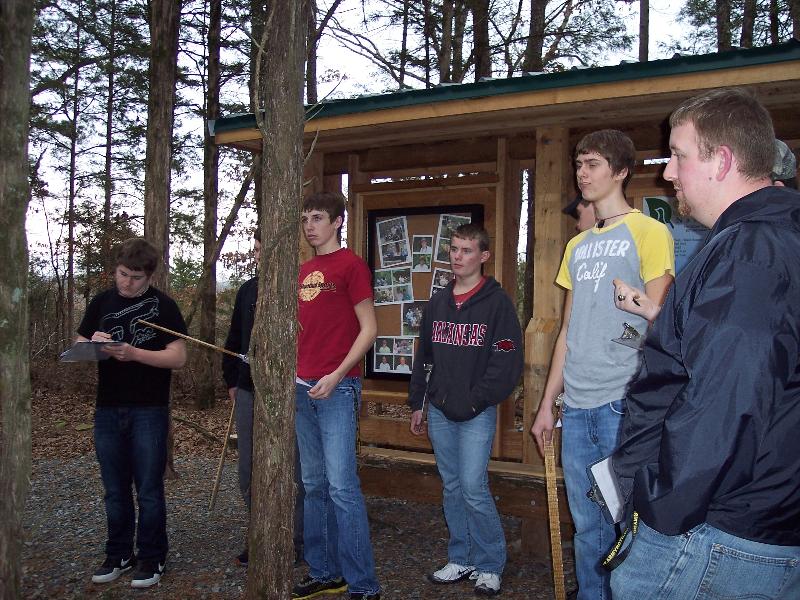
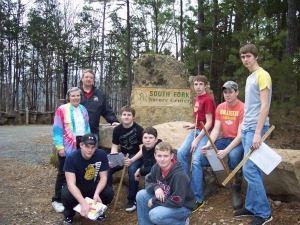
A van of seven enthusiastic “tree hugging” young men and their advisor, Mr. Gordon Eichelberger, from the Quitman High School FFA Forestry Judging Team, and myself, were greeted at the SFNC entrance gate by docent Steve Smith for an afternoon of tree identification activities. What a perfect afternoon! Who could have guessed a February afternoon could have permitted us to be on the trails in short-sleeved t-shirts!

Steve showed off the beautiful new entrance to the trail and the kiosk with all its handy information and explained South Fork’s mission.

Then back to the vehicles and Steve led us down to the Cabin where he shared the story of the Riddle Cabin and background of South Fork Nature Center. The boys practiced their forestry skills in measuring tree height and diameter, and then we hit the trails!

We quickly saw what a challenge it is to identify trees in winter — no leaves to rely on!! However, Steve and I gradually began to expose some of the secrets of tree identification using only bark patterns and colors, branching patterns, buds and overall tree crown shapes and silhouettes. Before long, the students could distinguish between white oak, northern red oak, southern red oak, post oak, black oak, water oak and black jack oak, all based on bark patterns and colors, and over all shape of the tree’s growth habits. They also learned to distinguish between the hickories, sweet gum and black gum, and many other trees such as dogwood, red bud, hop hornbeam, ash, black cherry and basswood. The students gave each other “pop quizzes” as we walked along the trail, making identification fun and challenging for the whole group.

forestry2

We were treated to a wonderful surprise appearance by one of the wood’s rarely seen residents – a flying squirrel! One of the boys tapped on a hollow eastern red cedar as the group walked past. Out of a hole in the tree shot an adorable little ball of brown fur with huge black eyes! The squirrel spread-eagled itself flat against the tree near the den hole and remained motionless as we observed it for several minutes. The kids noted the membranes connecting the front legs and hind legs, which act as a parachute to enable “flight”. They marveled at the flattened little tail, completely unlike the flicking tail of other squirrel species they knew. It seemed as if he was posing especially for us – when we moved to walk on, the squirrel scampered back into the den hole!

forestry1

Sighting the little squirrel was the perfect way to wrap up a very productive and fun afternoon in the woods of South Fork. The kids heartily thanked “Mr. Steve” for giving them his afternoon, said goodbye and we all packed back into the van for the return to QHS campus. From the back of the van drifted sounds of tired, but happy “guy talk”, a couple of snores, and a few exclamations of “I’m really hungry!” while Mr. E. and I were busy making plans for the next field day practice with the team before their competition in March…a perfect conclusion to a great afternoon at South Fork Nature Center for a group of bright, dedicated “tree hugging” young men!