“Medicinal & Edible Plants” & “Bug House”

By Docents Shirley Pratt & Joyce Hartmann

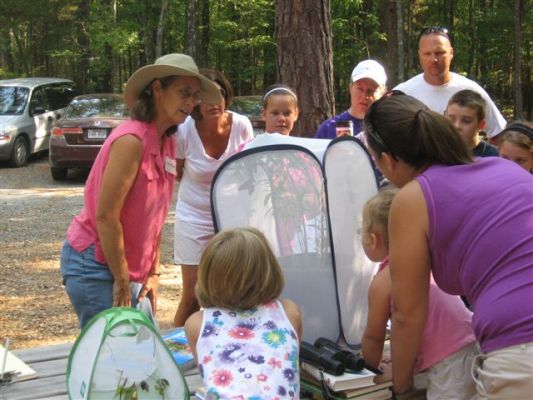
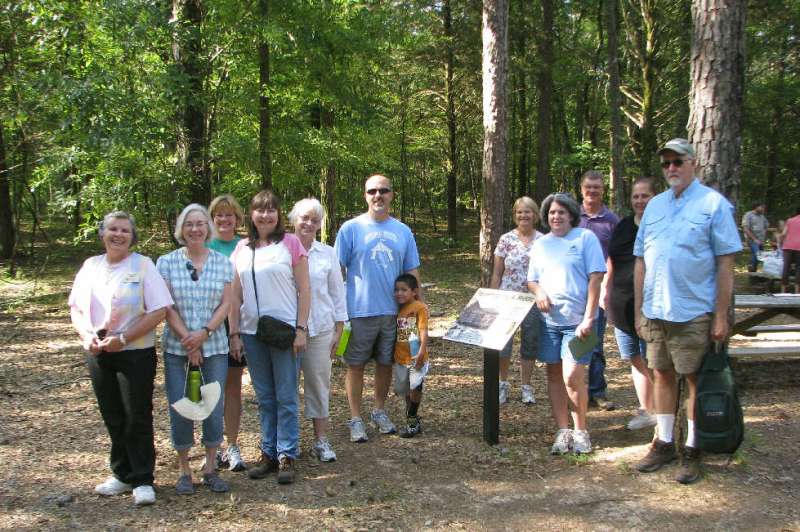
On Saturday, June 16th, an eager group met with docents Shirley Pratt, Kay and Bob Verboon, Joyce and Bob Hartmann at the Riddle Cabin for the morning of activities. A timely appearance by a very cooperative insect couple, Mr. and Mrs. Walking Stick made a welcoming salute at the registration table, very well choreographed in keeping the “Bug House” theme presented by docents Kay and Bob Verboon and Joyce and Bob Hartman. After an interesting overview of the SFNC background information by Bob Hartmann, Shirley’s group hit the trails.
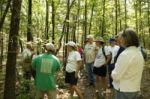
shirley-p-group

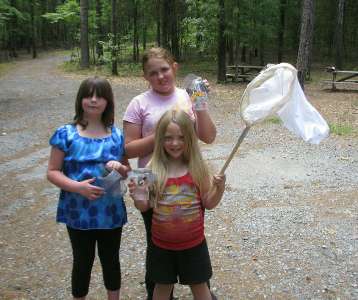
An enthusiastic group of three sisters joined Kay and Joyce. Kay led an interesting discussion on the importance and types of insects, while their toddler brother played in the cabin area with Dad and visited with the Pair O’ Bobs (Verboon and Hartmann), so Mom could go on the hike with Shirley. Kay provided a 12-page handout full of activities for children to do with their parents later. She then demonstrated how to make the little bug houses, assembled from plastic peanut butter jars.
bughouse

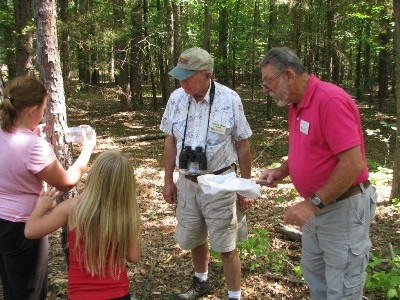
The children made little bugs from wooden ovals, painted them and glued them on the jars for decorations, and put a mesh screen on top of the jar, fastened by a rubber band. The Pair O’ Bobs helped them catch insects to observe and put in their jars.
june-walk

Back on the trail with Shirley……

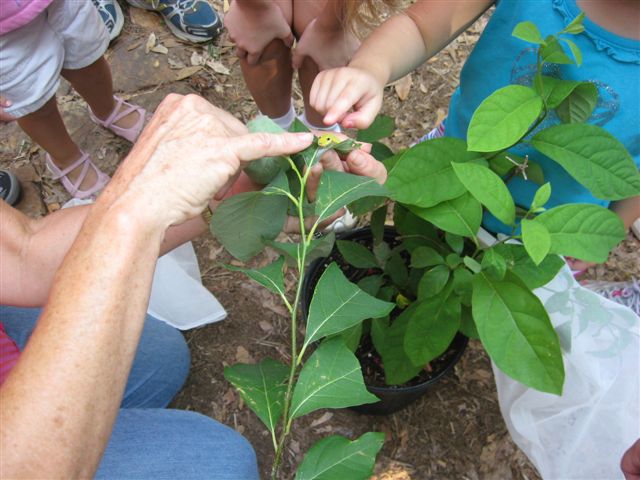
Needless to say, finding herbaceous plants to observe and learn about was the challenge of the day! Most of these more fragile plants had weeks ago given up the struggle to stay alive and thrive, so we had to reply on the trees and other shrubby plants with deeper root systems for our historic uses of plants.

Did you know that a tea made from dogwood bark would reduce the fevers of malaria? Confederate surgeons of the Civil War had to rely on dogwood bark and other herbs to treat the soldiers suffering from malaria and other fevers because they could no longer import quinine from Peru due to the federal blockade of southern port cities. One of our hikders demonstrated that dogwood tree leaves have stretchy elastic veins when the leaf is torn across the vein lines.

Do you have a lot of pesky thorny greenbriers on your property? Lucky you! The spring growth tip of the briers are very nutritious and taste similar to asparagus when lightly steamed and buttered — or just break off the terminal 6 to 8 inches of tender spring growth as you walk along and enjoy them as a tasty treat right on the spot. You may have to scout intently to find these fresh tender treats in spring — they are also a favorite deer browse food!

In the absence of cranberry juice in the region, Native Americans and pioneers had to use cedar berries as a diuretic to help with those occasional urinary tract infections. A cup ot tea made by steeping 8-10 fresh berries in hot water was welcome relief. For those annoying bugs in the house, such as ants, roaches and bedbugs, small cedar branches were cut and strewn along the traffice areas of the cabin floor. As the family walked on the fresh evegreen branches, the aromatic oils permeated the floor boards and the air, serving double duty as insect repellent and air freshener.

We even found several “bug homes” along the trail. Additionally, many tree leaves showed signs of hungry insects snacking on them! One very observant hiker even found a tiny baby walking stick insect, barely a half inch long.

In spite of the very warm and humid morning, our group of intrepid hikers returned to the cabin with a whole new way of looking at the trees in their yard!
Butterfly Release

butterfly-release6
By Roberta Katz-Messenger

The very popular butterfly program with Ruth Andre and a forest ecology and fire restoration mangement walk with John Andre was enjoyed by 32 participants. Docents Roberta Katz-Messenger and Steve Messenger were also on hand to help facilitate the day’s activities.

butterfly-release2

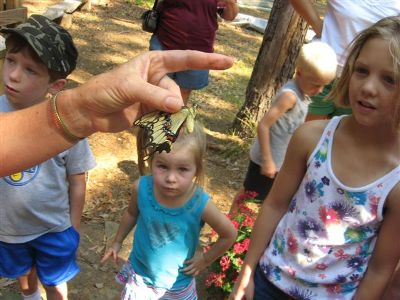
Ruth Andre, trained in environmental education and recently retired from teaching did a captivating presentation of live butterflies, their pupae, larva, eggs and host plants.

butterfly-release1

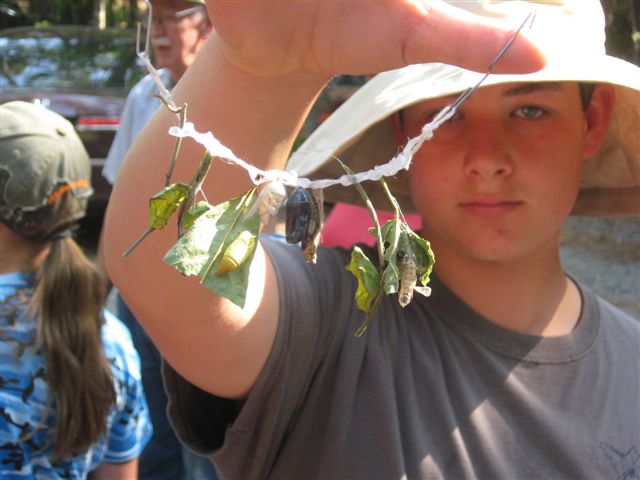
We saw the egg of a Red-Spotted Purple butterfly, a glistening mound on a leaf tip under one of the cabin’s microscopes. Ruth released gravid Monarch butterflies onto their host plants and in due time, we watched entrance as they laid eggs on the milkweed plant. One of the children spotted the orange and black wing of a Monarch inside a chrysalis about to release its guest.

butterfly-release3

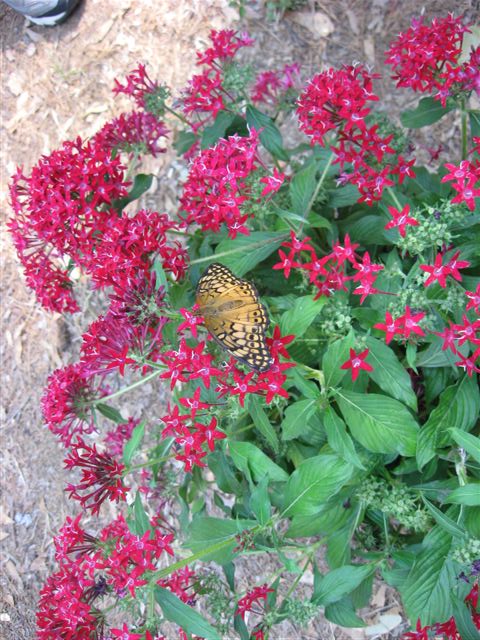
The children helped show everyone and then released Variegated Fritillary, Spicebush Swallowtail, Great Spangled Fritillary, Giant Swallowtail, Zebra Swallowtail and Pipevine Swallowtail. The larva of a Black Swallowtail, rolled discretely in its host plant leaf, entertained with a show of its armament of tiny twin red tentacles and pungent spray.

John Andre, retired from the U.S. Forest Service and an expert in prescribed burns, vegetation, birds and more, led a trail walk through the parched woods. He described the use of fire by Indians to manage their forest and fascinating techniques of examining “catface” burn scars of ancient trees and stumps to assess frequency of fire. “Witness trees” identified and recorded in early surveys assist researchers in understanding the composition of old forest, their current condition and the effects of these changes.

butterfly-release4

These data helped formulate current prescribed burn frequency. While controlled burning thins the forest to fewer trees per acre, it also creates conditions for healthy understory growth for many species most of which are beneficial to man and wildlife alike. In view of current dangerously dry conditions, John’s presentation was especially of interest.

butterfly-release5

Among the discoveries: few birds and creatures were out in the dry heat, but a lizard, bluejays and great blue heron were spotted plus lots of dragonflies.

As we returned to the cabin, the children spotted the Monarch chrysalis splitting apart, and as we all watched, it emerged and stretched its wings in their gentle care.

It was a fun and enjoyable day for all!

Arkansas Native Plant Society


By Don Culwell

On Saturday, May 19, 2012, twenty-one hikers arrived at South Fork to be led by Brent Baker in exploring the ecosystems on the peninsula. Gathering and greeting around the old cabin in midmorning, Almeda Riddle’s birthplace, Don Richardson of the Gates Rogers Foundation Board) welcomed the group and spoke about the history of South Fork.

Don Culwell addressed the mission of South fork, to educate the public in providing a greater understanding and love for nature, and noted the many and varied activities that have occurred as docents have lead activities from nature art to walks along trails learning about plants, animals, and their ecosystems.

Brent Baker, a botanist with the AR Natural Heritage commission who led the day’s walk along the trails, had join Theo Witsell way back in 2005, at the request of the Board, for the year-long study of all the plants growing at South Fork, a study that put South Fork “on the map” as being the tract of land in AR with the most intensive plant study anywhere in the state (their study and its findings are recorded in the Proceedings of the AR Academy of Science and are linked to the South Fork web site; www/southforknaturecenter.org).

Lunch at the picnic tables around the cabin provided time to rest with a bottle of cold water and discuss Native Plant Society activities as well as botanical finds of the morning. The day of hiking nearly 2 miles of trail was a fine one with a gentle breeze and temperatures around 80 degrees…it was a time to relax with friends from a week of one’s regular activities, and enjoy nature.

South Side School

10/6/11 South Side School’s 6th Grade Class

By Trish Childers

On October 5, 2011, teacher Julie Nelson brought the Southside School’s 6th grade science class to the South Fork Nature Center. There were 32 students along with six adult helpers.

The students were split up into groups so that each group was able to experience all four sessions. Our goal was to let the students see how their studies in the classroom fit into the organisms and environment of SFNC. Southside School

Each of the following Docents held a session:

Larry Bintliff was the coordinator for the day and conducted a walk in the woods along trails. Jim Solomon talked about insect and plant life at South Fork and showed examples from collections.

Steve Smith discussed the scientific names of plants and trees and covered leaf identification. Karen Smith and Marguerite Dory encouraged the students to write and keep a journal for their observations and experience in the out-of-doors.

Dan Smith discussed bird habitats, shelter, and predators. He also talked about the comparison of the fall changes in the trees and the changes in the birds at South Fork. Ed Wood and Janet Hill also helped during the sessions.


Students, teachers and Docents alike all had a great time, shared lunch together and enjoyed the warmth from the potbelly stove in the cabin. Many stated they couldn’t wait for the next program.

A note from Julie Nelson Southside Bee Branch Elementary School:

Thank you so much for the wonderful day at SFNC. My science classes had fun AND learned much in the process! From the nature walks to the bird talks, from the bug man to the journal ladies, the day was a great success. Being able to extend the learning of chemical and physical reactions outside the classroom helps my students realize that what they learn isn’t just found in the books we use, but all around them! A trip such as the one you planned helps my students realize that there IS a reason for what we are learning.


Again, thanks for all the help. Our trip was a pleasure and we look forward to returning, perhaps in the spring.

Julie` Nelson

6th Grade

Southside Bee Branch Elementary School

501-654-2200


Birding 101

Birding 101 at South Fork Nature Center

Trish Childers

On September 17th Docent Dan Smith gave a PowerPoint presentation on the fundamentals of bird watching, or birding as it’s commonly called. He also mentioned that a more advanced birding class is in the works, so stay tuned. Smith shared pictures of some of the most common Arkansas birds and talked about their songs, color recognition and other identification markers. Did you know that the fastest and easiest way to identify a bird is by the shape of its beak?

Smith also shared several reference books and the group was given the “Arkansas Backyard Birds” guidebook to start them on their birding experience. He also shared how to use and adjust binoculars for best results.

The weather was perfect for the docent tour, with only a few clouds in the sky and a light breeze. The gravel paths were dry, in spite of all the rain a few days before. The group took full advantage of the many benches along the trail to sit, listen and capture the image of a bird in flight.

In just about an hour the group was able to identify the following birds either by sight or sound: Common Crow, Kingfisher, Red-shouldered Hawk, Bald Eagle, Black Vulture, Turkey Vulture, Great Blue Heron, Chickadee, Pine Warbler, Pileated Woodpecker, Red-bellied Woodpecker, Blue Jay, Tufted Titmouse, Downy Woodpecker and Cooper’s Hawk. Several large nests were also spotted along the trail, but no one appeared to be home.

Docent Bob Hartmann was also along for the walk and helped answer questions that were raised about specific plants along the trail from several of the first-time guests.

South Fork has an ever-changing landscape; so mark your calendars for the next event – October 15th.