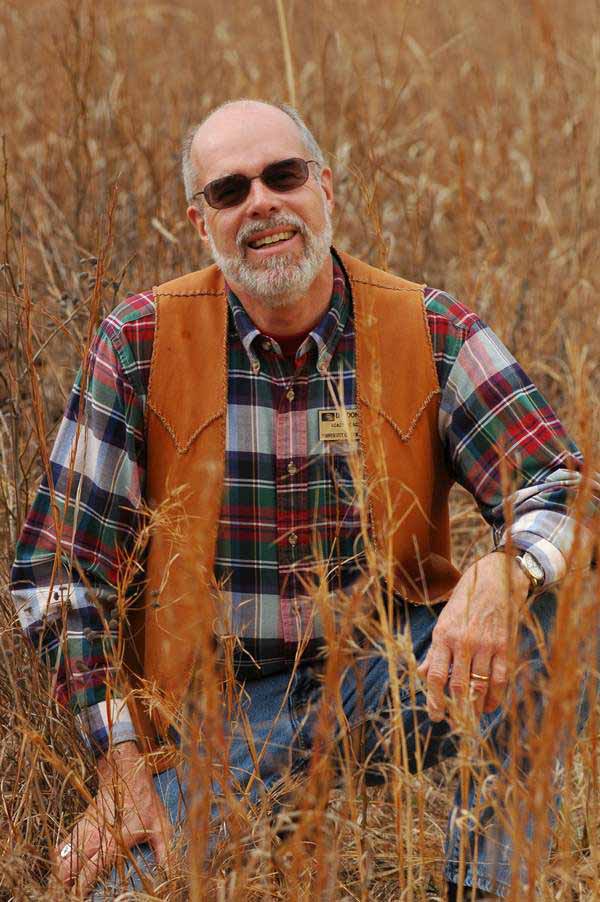
 by Don Culwell
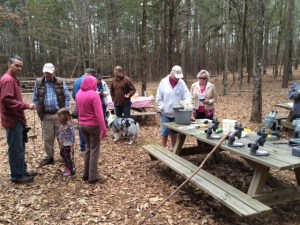
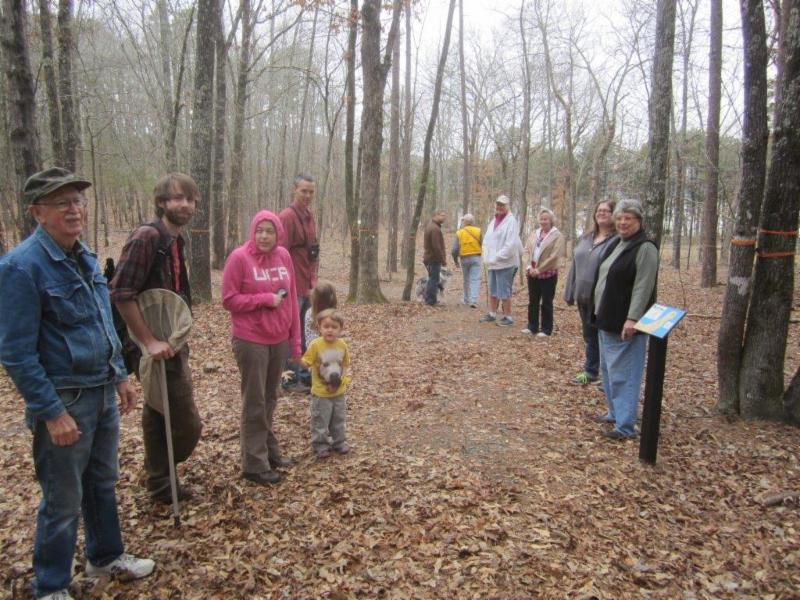
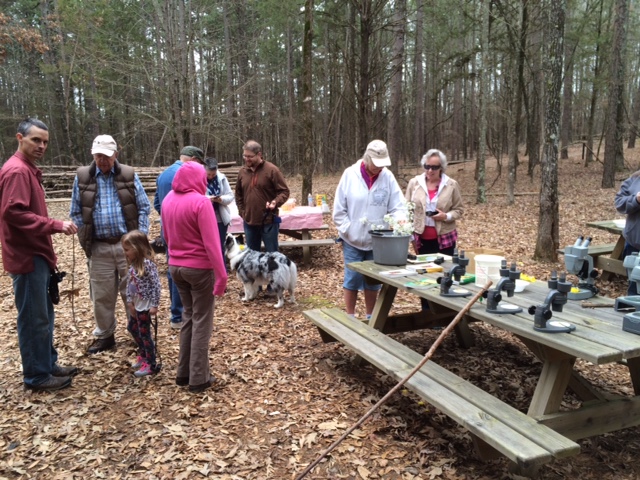
Fifteen folks gathered for peach cobbler on Saturday, March 21, around the coffee pot at the Riddle cabin. The sun peeked out from under the clouds a time or two. We made some new friends and caught up with others. Visiting got us going even before Don Culwell passed out jonquils from the roadside for use in checking out the life cycle of flowering plants. A hand lens helped identify the parts and note their functions: attraction of pollinators enabling sperm cells to reach egg cells (fertilization), embryo development, and seed maturation. Each individual species can grow from seeds and spread so that the population increases in size.
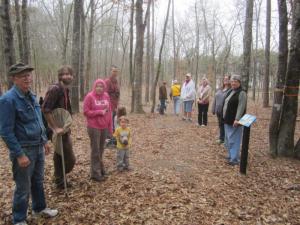 Out on the trail, we checked out all the growth activities of spring. Some of the red buckeye shrubs (Aesculus pavia) still had tight buds and larger ones at the tips of the branches that house the flower buds that will soon produce large Christmas tree-like inflorescences of long red flowers. After breaking open a bud we could see the tight cluster of miniature buds that were yet to begin their spring growth. But many red buckeye buds had already burst, hence throwing off their enlarged colorful bud scales revealing small green palmately compound leaves on a short stem below a cluster of the tight flower buds. Each of these flower buds will have flower parts much like the jonquil that we dissected.
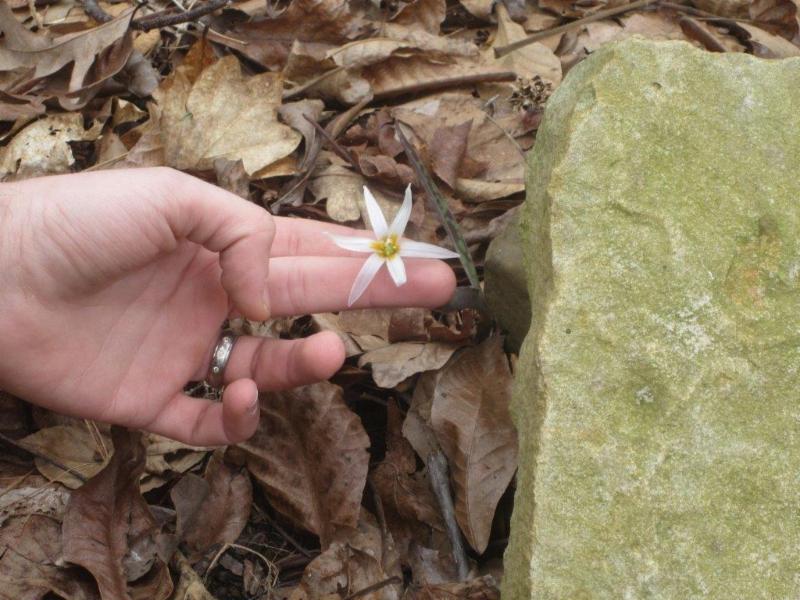
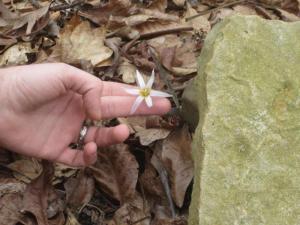 Wow! Here we see coming up through the fallen oak leaves, the maroon and green mottled leaves of the trout lily (Erythronium albidum) poking their plants through the leaf litter of winter. A single white nodding flower nearly two inches long arose above those mottled leaves. The buds are now visible nearby on leafy toothwort stems (Dentaria laciniata) and will soon burst into their clusters of white flowers.
Lifting pieces of rotting wood along the trail, one could see fungal threads of hyphae, the mycelium of several species of fungi with yellow and some white threads. These threads are the “roots” of the fungus that are already producing enzymes that digest cellulose of the fallen, woody limbs bringing about wood decay and thus nourishment for the fungus. This fungus will push up through the soil producing a mushroom that will make spores later in the spring or summer. Bob Hartmann noted the large variety of fungi which have many colors such as blue, red, orange, yellow, white, and brown. Why do you suppose there are no green ones?
 The pileated woodpeckers of South Fork had been busy throwing out large chunks of wood off the dead oak leaving quarter inch holes where they may have found some insect larval stage of development in some grub-like form.
Jim Solomon picked up several two inch hickory branches all neatly chiseled off from some hickory limb above. He noted how the hickory twig girdler (Oncideres cingulata) had neatly chewed the half inch branch all the way around until it fell. Tiny breaks in the stem beyond the cut revealed where the hickory borer had lain eggs. These eggs will now hatch in the twig on the ground and adults will emerge and mate in the summer. They will then begin to cut more hickory twigs where more eggs will be put into the twig, and the population grows.
Eager hikers continued on the trail, but noon soon arrived. The hand lenses and books were returned to the cabin along with the Coleman stove and coffee pot. good byes were said. The season of South Fork activity had begun and a Saturday morning had been well spent!


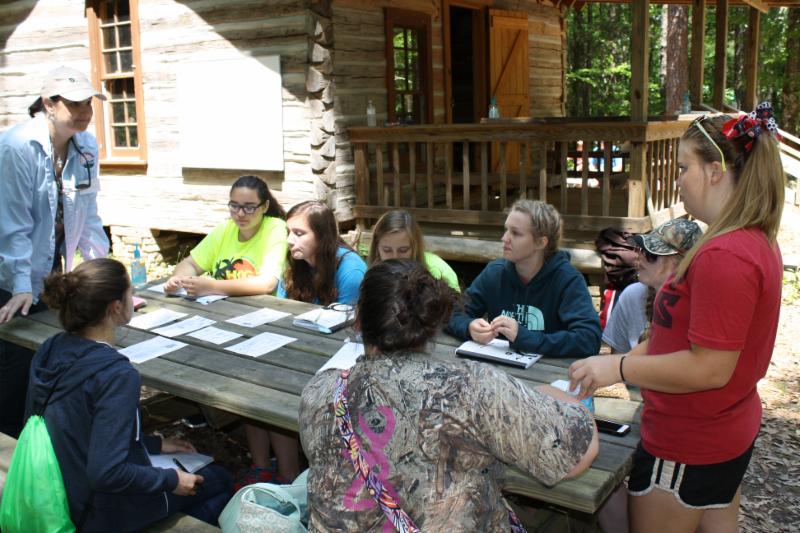

 South Fork Nature Center
You must be logged in to post a comment.