Winter Birds of Convenience & Purpose

South Fork - Turkey Vultures

If you were to visit the South Fork Nature Center area this time of year specifically to see local bird life, you might be somewhat disappointed. Birds are sometimes difficult to find in the winter woods.

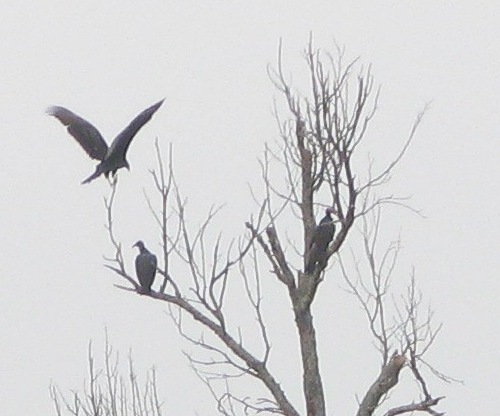
But do not despair; two kinds of large all-black birds can frequently be seen cruising just above the treetops or soaring high in the sky – those circling black specks way up there. These birds usually are either Turkey Vultures or Black Vultures, or both. They have large black wings which in flight are spread on a dihedral, putting the wings slightly above the bird’s body with wing tips held up at a slight angle. Their wings are built for soaring and gliding to take advantage of thermal columns of rising air to gain high altitudes with little or no wing-pumping effort.
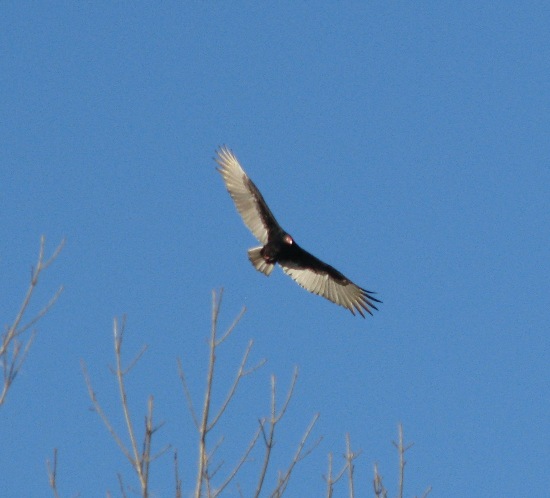
Turkey vulture

The Turkey Vulture has long tail feathers extending well beyond its body and a featherless red wrinkled-skin head, built for moisture control during feeding, while the Black Vulture has stubby, short tail feathers, easily seen when in flight, and also a featherless head but with black wrinkled skin. These features make identification of these similar birds quick and
easy.
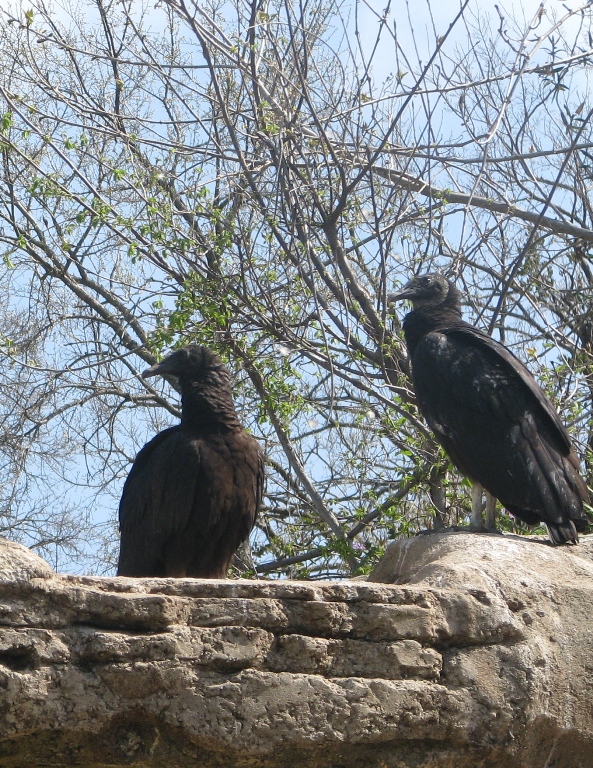
South Fork Nature Center - Black Vultures

The Turkey Vulture is extremely proficient at detecting dead things by smell; their olfactory system is so highly developed that they can recognize odors while soaring on those upward flowing air columns hundreds of feet high. From up there they scout for food, specifically dead, decomposing creatures. Even though Turkey Vultures’ eye sight from on high is not that
great they are usually the first to arrive at an undiscovered feast – frequently soon to be followed by groups of Black Vultures with an attitude.

Evidence of beneficial carrion removal at SFNC by vultures includes hollowed-out armadillo carcasses, poached deer parts and partial fish remains along cove shorelines. Frequently you may encounter vultures consuming a road kill and occasionally a dead vulture who had become a highway glutton unable to fly and avoid traffic.

We owe both vulture species a deep debt of gratitude for the speed and thoroughness by which they dispose of carrion reducing the likelihood of related disease in the wild.
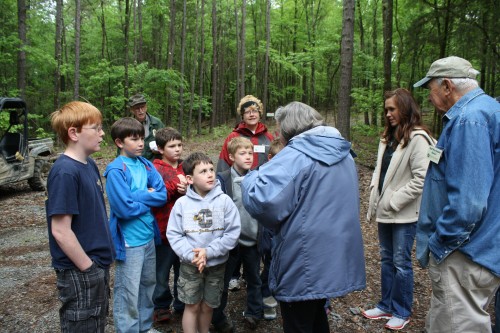
TEACHERS – Plan a Class Day at South Fork

With spring just around the corner, it is time for anyone teaching a class to schedule a session with your students at South Fork Nature Center…get your name on the schedule. We at South Fork are anxious to work with you on the appropriate subject content that addresses the environment for you or brings to life the study of organisms, both plants and animals for your students. Our docents will lead your students in small groups to see and appreciate the plants and animals in the out-of-doors as they experience them in their ecosystems on their walks and talks around the peninsula.

Please call Kathy Sherwood at the office in Clinton to arrange for your class (501-745-6444).

Students are led by docents in a search of life in eco-systems. The different teams will start at various points in the Nature Center such as the waterfall, out on the point, and deep in the woods.

“Take a Likin’ to Lichens”

by Don Culwell, SFNC docent

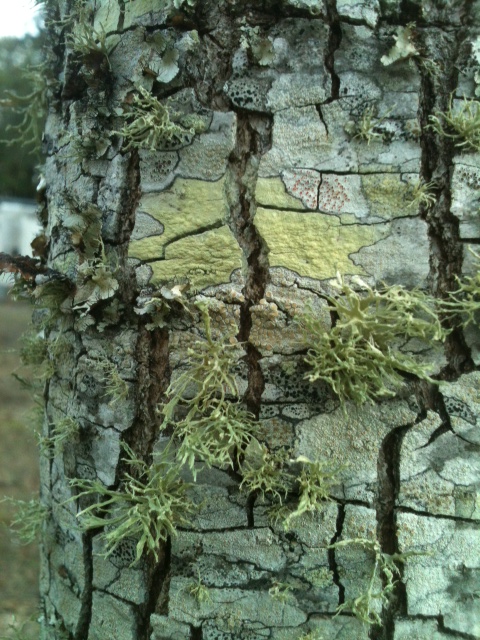
lichen1

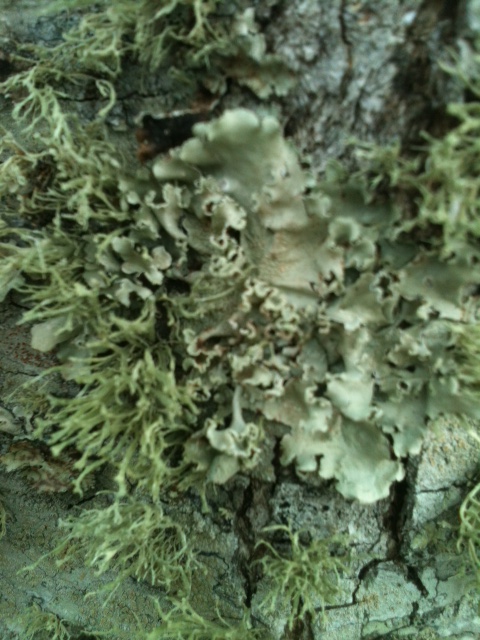
Those interesting, light and dark splotches on tree limbs and bark, some of which have curled up edges, some form little branching tree or shrub-like growths on limbs or on barren soil, they catch your eye. Some even grow in hanging masses from trees (like old cedars on a bluff) that cause one to wonder if what is being seen is Spanish moss. But, in Arkansas, it is most likely Old Man’s Beard, a lichen. And their colors, whether their growth is crusty, leafy, or branching, may be chartreuse, yellow, orange, or red; most often around central Arkansas they are seen as white to grey to blue-green, to black and even grey stalks with caps of red balls (which are British Soldier lichens).

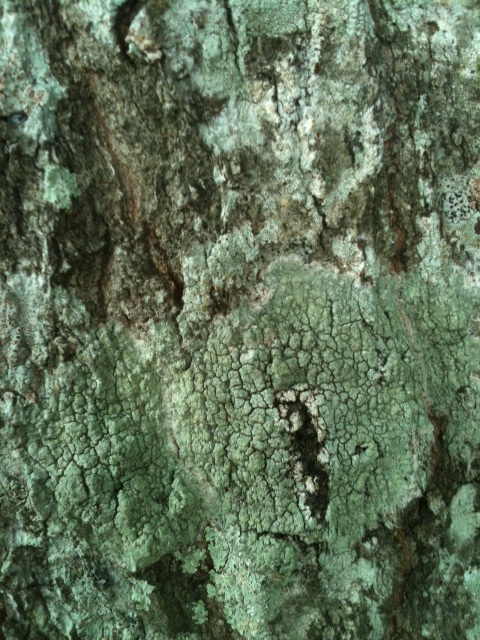
lichen2

These unique organisms are called “pioneer plants,” for they grow quite well on rock surfaces, tombstones, tree bark, and poor, bare soil where no other “plant” can exist…they are the first to inhabit many such surfaces in the ecosystem. They function in a symbiotic capacity, that is, they are made of fungal threads that we call “hyphae” and there are tiny rounded cells of algae all around and through their hyphal matt (a living association between two organisms, the fungus and the alga…we call this mass of cells a thallus). The algal partner here, being green, carries on photosynthesis when moisture is available, making carbohydrate molecules. The fungal hyphae provide a place, often a moist one, that “houses” the algal partner and absorbs carbs made by it. These lichens grow and prosper under good environmental conditions and quickly dry out when moisture is absent. Their mass of hyphae and algae grows, spreads its branching morphology, or flat, crusty mass, covering “pioneer surfaces” with their interesting patterns of growth.

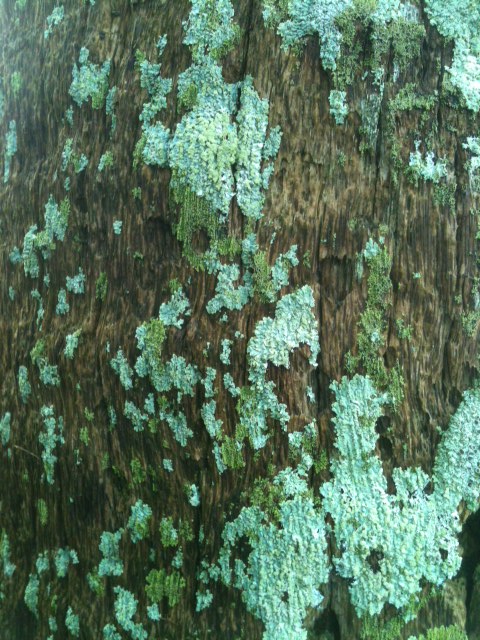
lichen3

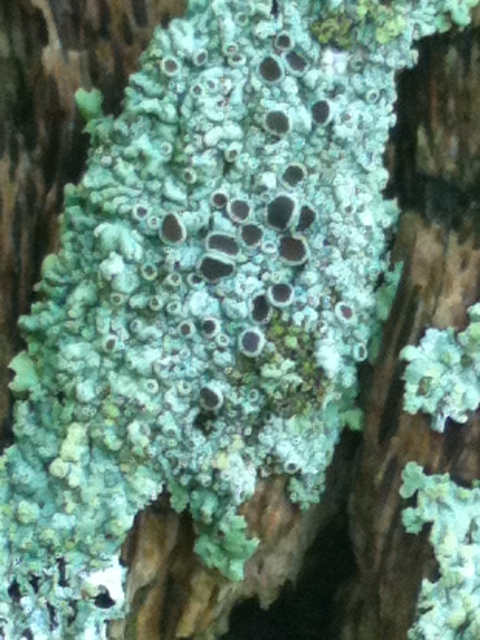
Reproduction within these lichens takes on interesting characteristics. Asexually (vegetative reproduction), tiny particles we call soredia (tiny bits of lichen) are dispersed by wind, water, or animals through fragmentation of the thallus; tiny, ball-like structures called isidia are also produced for dispersal. Small (or very tiny) cups or saucer and plate-like structures (maybe as much as a half inch in diameter) may be formed on lichen surfaces; often these are of a brownish or darker color. It is from within these cup or saucer surfaces that spores of the fungal partner are made. Only the fungus is reproducing here by spore production (a sexual process) which spreads the fungal partner.

lichen4

Lichens, like mosses, may be more obvious during the dormant, winter season…they are more obvious in ones’ line of vision with the leaves off the woody limbs. Take a walk in the woods and locate the crusty, the leafy, or the branched forms of lichen (crustose, foliose, and fruticose morphological forms). They will brighten your winter’s day!

lichen5

Glade Restoration Progress

by docent Bob Hartmann

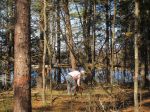
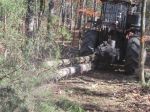
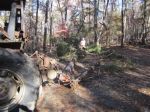
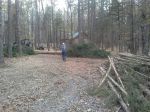
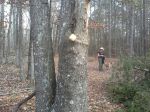
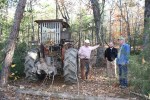
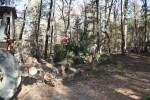
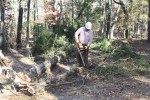
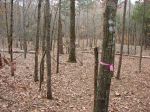
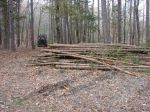
Project work began in mid November with Eastern Red Cedar removal from the first (the Seep Area) of three selected glade areas. All unmarked cedar is being cut at their base and removed. Trees marked with orange tape are being left in place. Downed trees are hauled out to adjacent road and parking area edges where topping, trimming and log separation is performed and for temporary storage.

In the last photo is an unusual, very edible ‘Lion’s Mane’ mushroom in prime plucking condition – but it wasn’t, only photographed!

Larger tops are to be moved to Corps of Engineer assigned drop-off sites to be used for fish habitat and attractor construction. Logs of fence and construction value will be relocated on property for future use. Trimmings will ultimately be burned in the roadway/parking area or moved to a suitable nearby burn site. Work on the second Glade site is underway.

Moss Reproduction

by Don Culwell, SFNC docent

This space in the December E-Newsletter described the tiny forest of moss “stem and leaves;” they are really no stem and leaves at all, for they lack any vascular tissue to conduct food and water up through the tiny plants (but they do not need this vascular tissue, for they are only tiny plants and can absorb moisture from their surfaces…they do it quite well).

moss-reproduction

Well, plants of this “moss forest” are involved in plant sex, and it is not the mating of tiny springtails and water bears that live among their leaves, although they may be there and doing sex, too. (You see, sexual reproduction is vitally important to all organisms that can manage it. This process produces new combinations of genes that form offspring that are a bit different from their parents, offspring on which natural selection by the environment can act …a subject for another discussion in this space).

Located in the tops of green moss plants sit tiny, thin walled containers where eggs and sperm are made, sperm that have flagella (whip-like hairs) that propel them to the eggs. These flagellated sperm can swim through the film of water on the surfaces of moss leaves, water not only from splashing of rain drops bouncing sperm all over, but water that accumulates on moss leaves from a heavy dew-fall or mist on a drippy day. Many sperm cells are made inside each tiny, thin walled, ovoid sac we call an antheridium. You see, many sperm must be made which insures the fertilization of just one egg, since these sperm are splashed about all over the place, not just toward an egg.

So, these sperm cells swim to the eggs, eggs that are found in archegonia, one in each archegonium. Archegonia are tall, thin, vase-like structures with an enlarged base big enough to hold just one egg…each archegonium has a tall, thin neck with an opening all the way through it…it is down through this long neck that a sperm swims. Ultimately it reaches the egg and “ZAP,” it’s been fertilized…the sperm and egg fuse (one set of genes from the male plant and one from the female plant)…a zygote is made with 2 full sets of genes in the cell, one from each plant. Now, isn’t that just the neatest thing, the best way to make a new moss plant?!

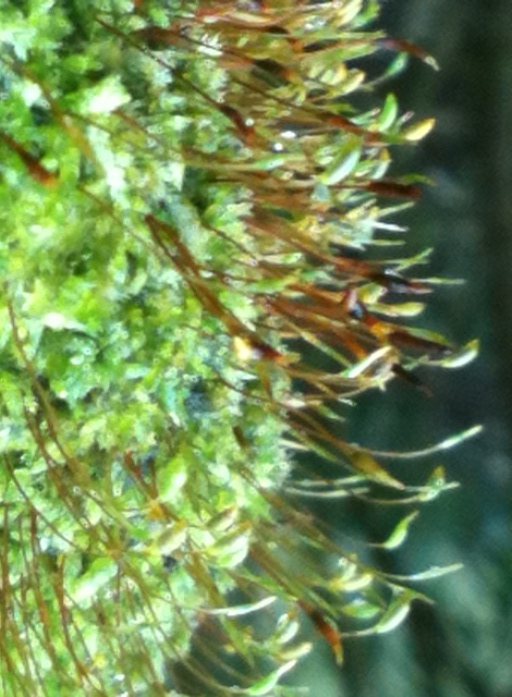
This new zygote cell grows into a taller, whisker-like hair still attached to the top of the tiny, green moss plant…many of these are spread over the top of a pad of moss plants at some time of the year…many of them, sometimes much taller than the green, leafy moss plants they are on top of. And this gives a very “hairy” look to the “moss forest”.

Way at the top of each of these tall “hairs,” one from each plant bearing it, is a rounded or elongated capsule inside of which many, very, very tiny spores will be made. Each spore cell contains only one set of genes (not the 2 sets that were put together by fertilization making the zygote cell). This one set of genes is put in each spore through a process we call meiosis, or a cell division that reduces the number of chromosomes in each cell from that division process. At just the right moment when these spores are mature, each capsule bursts open by teeth under the cap at the top and spores are released into the wind. These spores are blown everywhere and germinate to grow into the first green cells (protonema) that will form green mosses that you so easily can see.

So, now you know how mosses come to be…and they usually are seen growing in large masses on soil, on tree trunks, or on rocks in shady places in the environment where it is more moist. Here their cells can easily get water when they need it…this is just SPLENDID!

Nature Center Maintenance Update

The Nature Center will reopen on Tuesday, January 7th, 2014. We apologize for any inconvenience the closure may have caused. Additional Glade Restoration work will be scheduled in the near future.

Take a look at the work in progress!