Listen up!

by Bob Hartmann, SFNC docent

Since mid to late September in our ‘neck of the woods’, including SFNC, we can hear three resident owl species ‘sounding their stuff’ just about every evening, weather permitting. Some begin their territorial declarations about half an hour before sunset, sometimes earlier and may continue well after sunset. By fall’s end theirs mating melodies, of calls and answers have arrived and slowed, but may persist. On quiet evenings LISTEN UP!

Barred Owl photo taken by Joyce Hartmann

Check out these ‘youtube’ sources where the varied songs of these three may be found, heard and committed to memory:

Barred Owl (Barred Owl Amazing Vocals!) at <a href="http://www.youtube.com/watch?v=fppKGJD3Y6c&quot; target="_blank"www.youtube.com/watch?v=fppKGJD3Y6c

Great Horned Owl) Great Horned Owl Hooting Territorial Evening call at www.youtube.com/watch?v=p4CRqJJW6S8

Eastern Screech Owl (Eastern Screech Owl Call) at http://www.youtube.com/watch?v=DOMCHegQA7A

Before ice or snow arrives nests may be occupied, some with eggs. For the larger owl species abandoned Red-shouldered Hawk nests are choice.

So, now you still have time to LISTEN and LOOK UP!

“The Miniature Moss Forest”

by Don Culwell, SFNC docent

Most all of fall’s color has faded, many leaves have fallen or have been driven downward by the wind, and few living blades seem to be around anywhere…it is what some may call the “dead of winter.” These days are the times when it is exciting to be outside on a pleasant, sunny day looking at the mosses and lichens that are all alive and well.

Without the major green leaves of the forest and the grasses and forbs along the path or in the glade, one can more easily find the little hummocks of green that are mosses or the colorful lichens on bare soil or rock surfaces…they show up now. Bark surfaces of trees provide a place for the microscopic moss spores, blown there by the wind, to germinate and grow into long, branching threads we call protonema. And they cover the bark on trees everywhere, and even can be seen on the surface of the bare ground and rock producing a greenish cast (almost like that of a coating of green algae) for the critically observant eye. It is from this minute matt of moss protonema that small leaves, just several cells thick, grow on tiny stalks as they make a soft, velvety covering of moss plants, the small stalks bearing clusters or stacks of leaves more obvious to the human eye (or, I suppose, that of the observant skink or turtle, as well)…these green mosses are more obvious than the protonema were. Green moss leaves, tiny and thin as they are, photosynthesize just as any other plant structure with chloroplasts…they are “producers” in the ecosystem, producers that are just “going to town” now in the light of the winter landscape…these leaves are more readily seen in winter, and are of such delicate beauty, especially when seen through a hand lens. Can you spot the tiny teeth along the margins of a moss leaf…and the midrib stands out, too!

So many of these tiny leaves all arranged on each moss stalk gather moisture from the dew-fall, from a mist of the wet air, or from a more drenching rain. (You see, mosses have no vascular system with which to transport water from their “roots” up to these “leaves.”) Water soaked in through the leaf surfaces and the carbon dioxide absorbed from the air provide the raw materials from which the photosynthetic machinery of each cell (powered by light) is enabled to assemble molecules of sugar. And it is this sugar that provides the nutrients for life needed by the moss plant itself. The moss hummock or moss covering of the tree bark grows into the soft, velvety surface that always beckons a gentle touch of the hand…just gently feel it…go ahead!

Do go out and enjoy the bryophyte flora we call mosses…do it today!

Arkansas Citizens First Congress

by Don Richardson, SFNC docent

On November 9th, the Environmental Caucus of the AR Citizens First Congress met at Choctaw and after the meeting 13 walked the Nature Center trails. Docents Bob Hartmann and Larry Price led the discussions on the trail. There was a lot of interest in farkleberry trees and everyone ate some of the berries. It was a good interesting walk with a lot of great conservationists.

Glades at South Fork Nature Center

by Brent Baker of the AR Natural Heritage Commission

Glades are naturally open areas with thin soil, often with bedrock or a layer of impermeable soil near the surface. These areas usually have few or no trees due to the shallow soil, often in association with a natural fire regime. Glades are usually dominated by grasses and forbs (wildflowers), sometimes with scattered shrubs or areas of bare rock or rock covered with lichens and mosses, often grading into open woodlands.

In the absence of fire, some shallow-rooted trees like eastern red-cedar can become weedy and form dense stands, shading out the herbaceous plants. This is what has happened on the approximately 10 acres of glades at South Fork Nature Center. To restore the Nature Center’s glades, many of the eastern red-cedar trees will be mechanically removed (cut). The branches will be burned on site, the tree tops will be sunk in Greers Ferry Lake for enhanced fish habitat, and the logs will be stockpiled for future use at the Nature Center.

This work is being funded by a $10,000 glade restoration grant from the U.S. Fish and Wildlife Service and is to begin around November 17, 2013. Once the eastern red-cedar trees are removed, the glades at the Nature Center will be maintained with prescribed burns on a periodic basis to mimic a natural fire regime (roughly every three or so years) to kill any red-cedar seedlings and saplings and maintain the open, herbaceous character of the glades. Interpretative signs will also be placed along the trails through the glades to explain this unique habitat.

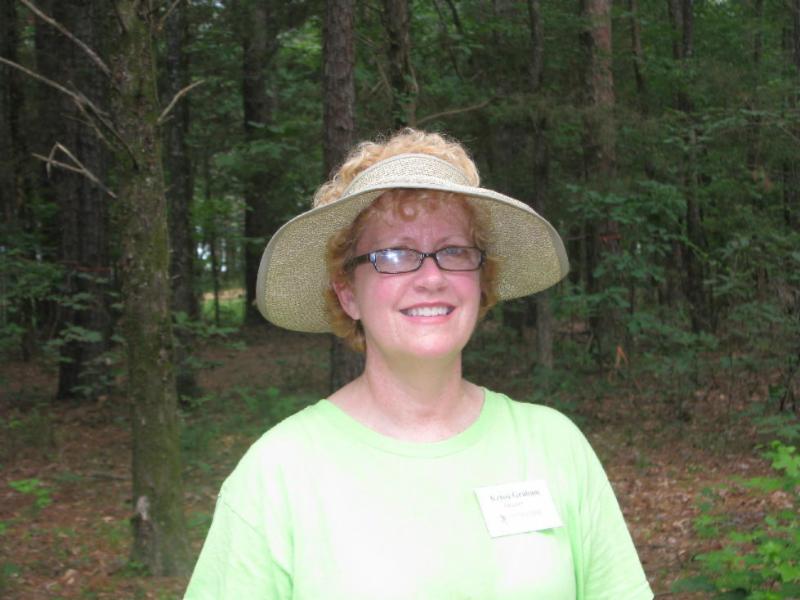
Krissi Graham & CHS Enivronmental Club

Perfect outdoor weather plus an outdoor cooking class plus 24 friendly, hungry people equals an awesome experience for students at Clinton High School! Mr. Marlin Partney had the gear and supplies for all of us to cook cobbler in a Dutch Oven and our meal in a foil pack. Mr. Partney is active in Scouts, hiking, camping, and teaching his favorite topic “Leave No Trace”. We also hiked the trails, led by student docents, and had an interesting presentation by Hilda Littleton about Indian customs and survival techniques. Thank you, everyone who helped make it an amazing day in the forest.

Clinton School Teacher Krissi Graham