Nov. 15: America Recycles Day

ARD-Logo(CMYK)REVISE

What habits will you change to be more mindful of the environment? With the cooler months, and the busiest commercial season of the year, come massive amounts of resource consumption. We use more energy & fossil fuels, buy & dispose of more processed materials, and spend less time getting in tune with nature. Please take a moment to consider ways to conserve & contribute to the well-being of our precious natural world, and ALL who share it! 

FAMN October Visit

Docent, Bob Verboon
famn-tour-of-south-fork

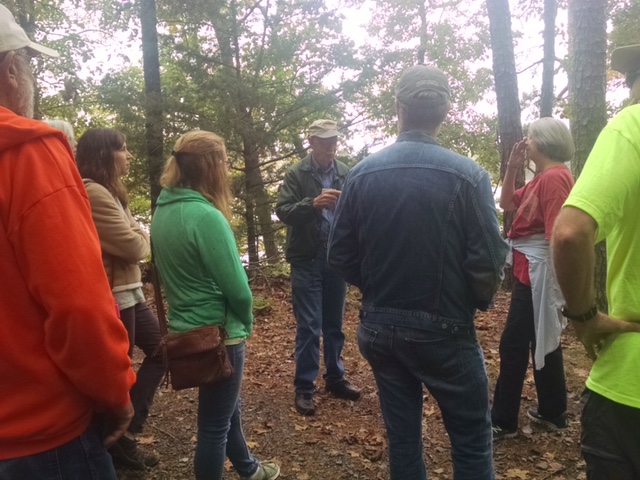
On Saturday, October 15th, eight members of the newly formed Foothills of Arkansas Master Naturalists met at Southfork for a trail walk and tree planting. Arkansas Master Naturalist state president Katherine Becker presided over a brief meeting with the group and then Bob Verboon, Southfork docent and Master Naturalist in North Central Arkansas, covered the history on how the Gates/Rogers Foundation came to be and how Southfork developed into the Nature Center it is today.

The day began with a trail walk led by docent Dr. Jim Solomon. Jim captured the attention of the group with his vast knowledge of both beneficial and damaging insets of the forest. After a picnic lunch, part of the group stayed to plant 10 black walnut trees on the south end of the peninsula. The trees were donated by board member Bob Hartmann.

Continue Reading: What is a Master Naturalist? →

Foothills of Arkansas Master Naturalists

What is a Master Naturalist?

Master Naturalists are all volunteers, but their interests range widely. Some really enjoy cleaning up area hiking trails, while others have fun looking for tiny critters in local creeks. Some like identifying and mapping native plants and wildlife in state parks. Others derive satisfaction from coaxing wildflowers to bloom in a meadow or cultivating native and other plants useful to early Ozark inhabitants.

However, they all love learning more about nature, while doing what they can to keep the natural state natural. And every fall they start hunting for more like-minded individuals.

The newly formed chapter of Foothills of Arkansas Master Naturalists (FAMN) recently opened applications for a new class of volunteers for 2017, according to chapter president Tom Nowlin. The chapter invites residents who are interested from Heber Springs, Conway, Clinton and surrounding areas to apply.

The course for “Naturalists in Training” begins January 28 and concludes with graduation May 6. The application form and class schedule are available on this web page: http://wordpress.arkansasmasternaturalists.org/how-do-i-join/. (Scroll down to “FAMN.”)

“New members have a lot of fun learning about everything from rocks to plants and animals found in the Ozarks,” says Nowlin.

Experts teach classes in eco-regions, geology, astronomy, mammals, Interpretation, entomology, herpetology, ornithology and botany. Lessons also include practical skills like stream monitoring and trail maintenance. Nowlin emphasizes that you do not have to have a college degree to participate. Everything you need to know to be an active member will be provided during the training. Students receive their own guidebooks in many fields. Age is not a factor either.

“But there are no exams,” Nowlin reassures. “We learn by listening, observing and doing. We also schedule special advanced training classes in various topics for all members throughout the year.”

FAMN members will also organize purely recreational activities, such as hiking trips on area nature trails and float trips on the Buffalo River and other streams in the area, he added.

Ongoing projects will include monthly stream water monitoring on local streams. Stream team members evaluate local creeks by testing water chemistry and collecting and counting bugs and other critters in different creeks, including Archey Fork and the Little Red Rivers in Van Buren County.

New members’ classes begin January 28, with orientation at the Faulkner County Library in Conway. Other classes will be held at the Fairfield Bay Education Center and Fairfield Bay Marina, the Van Buren County Library, Clinton City Park, the University Central Arkansas, Conway, Petit Jean State Park, Arkansas Game and Fish Commission, Mayflower and Woolly Hollow State Park to name a few. The class is limited to 30 applicants, so Nowlin urges interested persons to apply soon.

For more information, prospective volunteers may email Tom Nowlin at twnowlin@artelco.com or call Tom at (501) 723-5122.

Nemo Vista Student Trip

Nature Center students from Nemo Vista

NEMO VISTA COMES TO SOUTH FORK

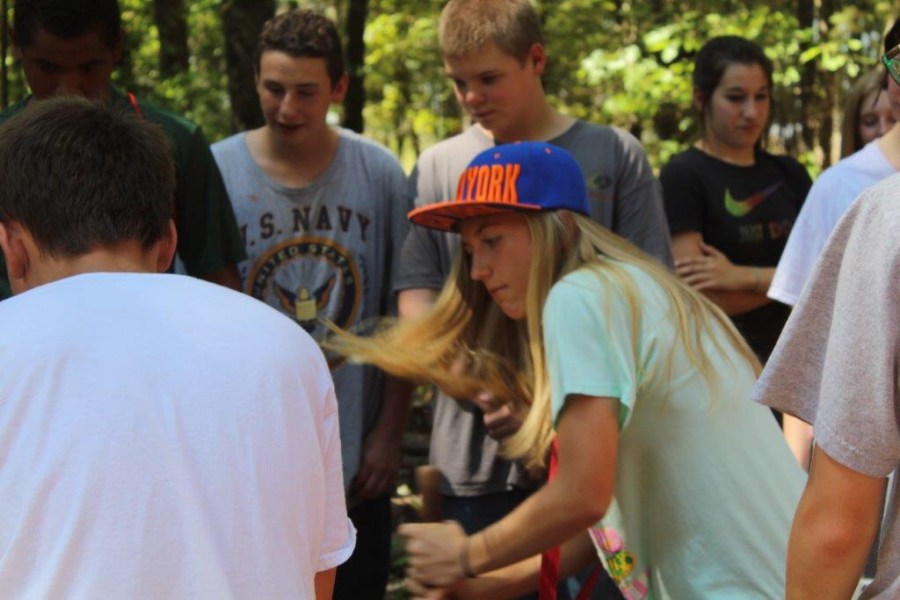
On Wednesday, September 14, the big orange bus climbed the last hill north to the Nature Center. The door opened and out stepped 45 ninth graders, all anxious to hit the trails. Scott Perry, their civics teacher, Jared Price, their biology teacher, and Logan Williams, the Dean of Students, had brought them for the day. After a brief introduction to South Fork, Don Culwell led them past the kiosk at the trail head for the half mile walk to the Riddle Cabin.

Already just past the entrance, students were asked to look up into an aged, white oak standing somewhat bent over in the forest canopy. They were challenged to “read the woods” by observing this “long-time forest resident.” They discovered that lightning had broken the top out many years ago leaving a long, gaping scar all the way down its trunk to the base where an 8-10” opening, now many years later, had rotted away leaving some shelter for an animal in its cavity. Lightning? Yes, the top had been blown off; side branches had continued grown upward through the opening in the canopy brought on by the storm of years ago. Look, listen, and “read the woods” for what you can glean from the forest. Who lives there, what is going on? This began the day of fun and excitement.

Arriving at the cabin from the trail hike, four groups were organized for morning sessions spent with docents: flowers and trees along the trail, journaling about forest life while sitting in a wooded bench circle, insect biology and life along the trail, and the pioneer craft of soap making and its chemistry (from way back in the days when the 100 year old cabin had been built.

After a sack lunch for students at tables outside the cabin, they all had their turn at taking part in old time activities. Using a long, cross-cut saw cutting several, big, pine logs 12-18” in diameter were cut as two students pulled the large saw teeth back and forth across years of wood rings laid down by the once living tree. Other students jumped rope while two students turned the long, rope arc for a student to jump, even two jumped at a time. In the dust on the ground another group of students was shooting marbles trying to knock their competitor’s marbles out of the circle, winning the marble he could bump out.

When 1:45 rolled around, activities moved back to the cabin porch. Summing up the day in a wrap-up session, students recalled the day’s fun in the “outdoor classroom” and headed up the road to the bus around 2:00 in time to get back to campus before school ended. Another fine day, but the learning had been in an unusual classroom, one everybody appreciated! The slogan “no child left inside” had surely been followed!

Log Rails for Clinton City Park

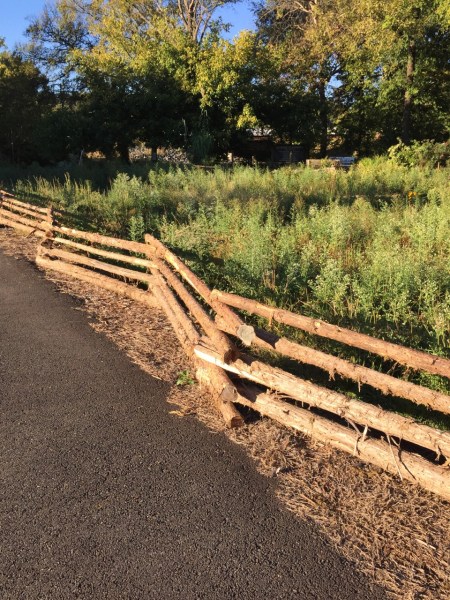
Carol Corning has continued enhancing the Clinton City Park with log rail fencing around the pollinator meadow. Ten foot logs of smaller diameter were cut from wooded areas at South Fork where glade ecosystem habitats were being restored enhancing the growth potential for herbaceous plants at South Fork; here many flowers can grow that butterflies can visit for their needed nectar food supply.

Assisting the in the City Park project funded by the US Fish and Wildlife Service, partners for the Fish and Wildlife Program, on September 9 were Joe Krystofik and Jonathan Baxter from the USFWS, who carried the logs from SFNC to the park. Trips on two different days brought over a hundred logs for use along the park trail. Glade restoration currently in progress at SFNC has also been done through a grant from the US Fish and Wildlife Service.

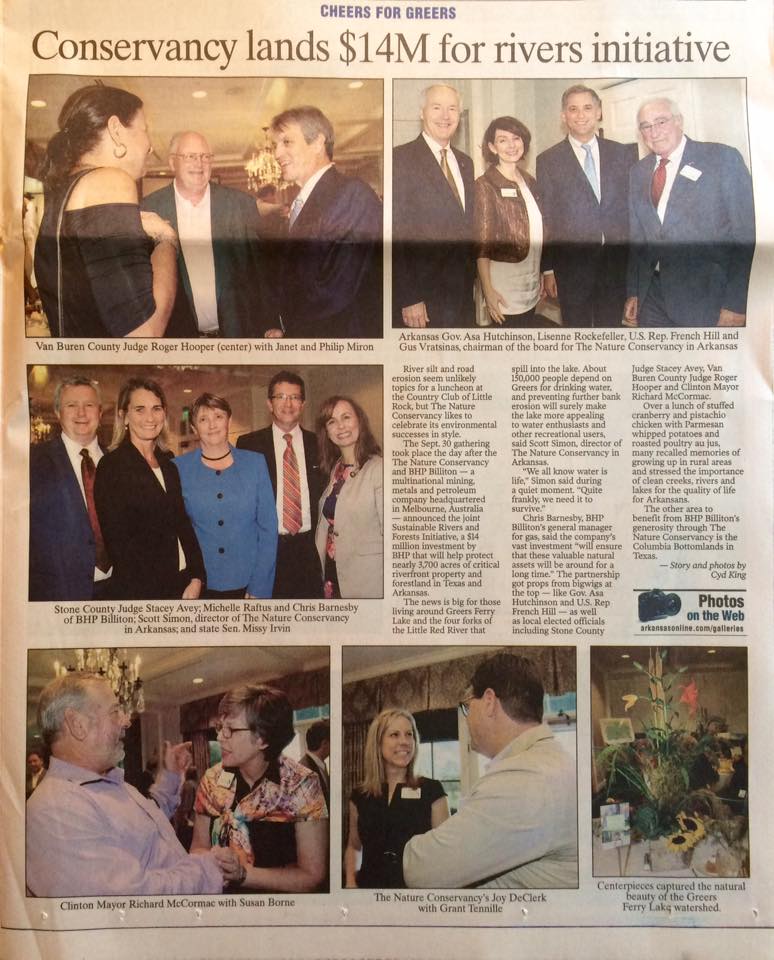
“Cheers for Greers”

That was the headline of a recent feature in the Arkansas Democrat Gazette, highlighting a Nature Conservancy banquet held in honor of a new partnership with BHP Billiton. Representatives of the Nature Center & the Greers Ferry Lake area were present to commemorate the $14mil conservation grant that will help preserve water quality & habitat in critical areas of Arkansas and Texas. Stay tuned for more exciting news from the hard working Nature Conservancy team!

tnc-sfnc-conservation-grant

Press Release

$14 Million BHP Billiton Donation Protects Rivers and Forestlands in Texas and Arkansas

Joint initiative with The Nature Conservancy targets globally important conservation priorities.
Little Rock, AR | September 29, 2016

Today The Nature Conservancy and BHP Billiton announced the joint Sustainable Rivers and Forests Initiative, which has led to the protection of nearly 3,700 acres of critical riverfront property and forestland in Texas and Arkansas.

Funded by a $14 million donation from BHP Billiton, the program has helped the Conservancy renew conservation efforts near Houston, the fastest growing metropolitan area in the United States, and will enable nearly a dozen restoration and water quality improvement projects to benefit drinking water, fishing habitat and rare species in Arkansas.

“BHP Billiton is excited to partner with The Nature Conservancy on this critical conservation initiative. We look beyond our operations to identify opportunities that enhance the resilience of our natural environment because we recognize that watershed protection through critical habitat conservation has a far reaching impact,” said Steve Pastor, president Petroleum Operations, BHP Billiton.

In 2013, BHP Billiton approached The Nature Conservancy about making a lasting commitment to conservation in the two states. The selected sites, the Columbia Bottomlands in Texas and Arkansas’ Greers Ferry Lake watershed, were natural choices—each area is considered a national conservation priority and the work will benefit both people and nature.

“For decades, The Nature Conservancy has recognized that the private sector has an important role to play in advancing conservation,” said Laura Huffman, Texas state director for The Nature Conservancy. “We applaud BHP Billiton’s leadership for pursuing conservation as a business strategy and for a level of investment that will make a lasting difference in both states. We have a shared commitment to improving our communities and protecting the natural systems that we all depend on.”

In Texas, the Conservancy has purchased close to 1,900 acres of forestland on the Brazos and San Bernard rivers, in a region southwest of Houston known as the Columbia Bottomlands.

Protecting and restoring the old-growth forests in this region protects water quality in the Brazos, San Bernard, and other important rivers and streams. The Columbia Bottomlands are also one of the largest and most important migratory bird stopovers in North America, supporting more than 200 species of birds.

In Arkansas, BHP Billiton’s investment has enabled the Conservancy to purchase 1,840 acres along the upper Little Red River. Located in the scenic Ozark Mountains, Arkansas’ upper Little Red River is home to more than 80 native fish and aquatic species; more than a dozen of them are rare, and some are found nowhere else on Earth. The river also supports Arkansas’ robust tourism industry and is a tributary of Greers Ferry Lake, a source of drinking water for more than 150,000 people and a recreational area for millions.

“The health of Arkansas’ rivers, lakes and streams are dependent on good water quality,” said Scott Simon, Arkansas state director for The Nature Conservancy. “BHP Billiton’s investment will play a critical role in shaping the future of Greers Ferry Lake and the rivers that feed it, not only through the initial land purchases, but through the planned water quality improvement projects in the watershed.”

The initiative will fund nearly a dozen water quality improvement projects ranging from reforestation, stream restoration and unpaved road improvement, which will ultimately serve as demonstration sites. The properties will also offer people from neighboring cities and communities, researchers, partner organizations and schools opportunities to spend time in nature and learn about conservation in these important landscapes.

“Working with The Nature Conservancy ensures that BHP Billiton’s contribution will create long-term value for the community and the environment in these areas of national conservation significance. These investments in Arkansas and Texas provide benefits that will outlast our operations for generations to come,” said Pastor.

In addition to funding important conservation work in North America, BHP Billiton has invested in Conservancy programs in Australia and Chile.

Read more from The Nature Conservancy in Arkansas: http://www.nature.org →