Milkweed Update

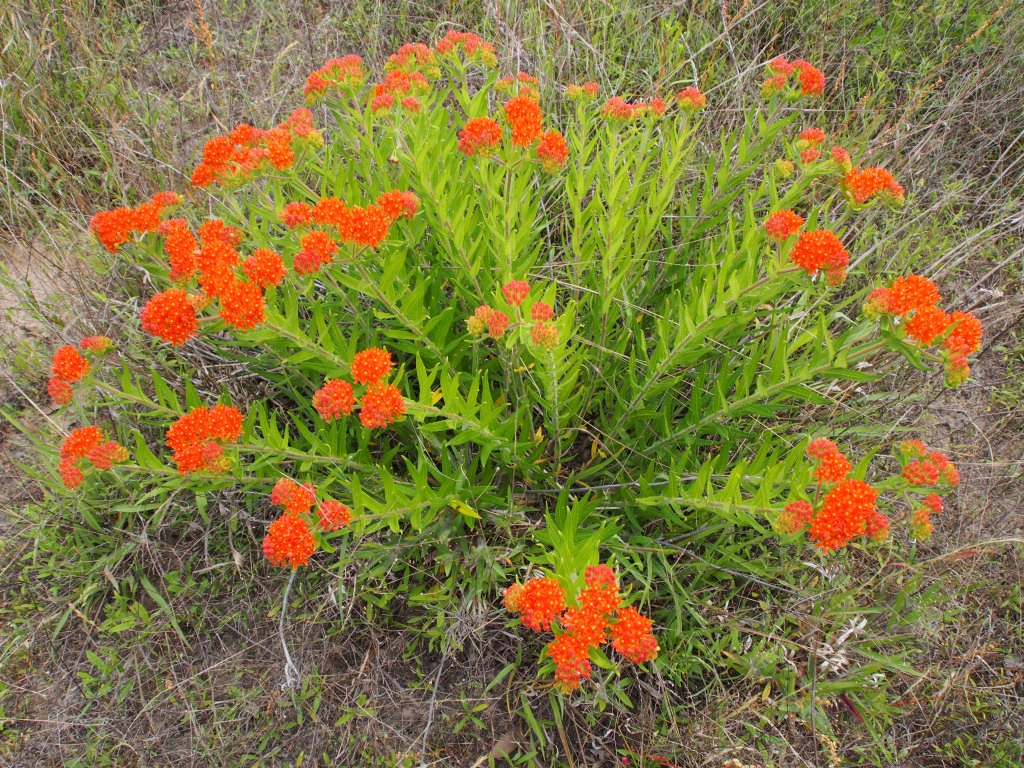
Milkweed plant - Brent Baker

Don Culwell
Twenty-four populations of milkweeds, largely Asclepias tuberosa (orange butterfly milkweed) and A. verticillata (white whorled milkweed)…432 plants in all…recently planted on the ten acres of glade ecosystem at South Fork are happy and doing well with what appears to be better than ninety percent survival rate! More than six inches of rain has fallen on the glades since they were planted during the week of June 21, 2015; watering teams have made the rounds several times with nearly a quart of water for each plant during a few dry periods in the open glades. It is important for the young plants to become established with good root systems to carry them along during drier periods, and that appears to be happening from the growth that can be seen. Many plants have grown twelve to fourteen inches with leaves that are nearly normal size…a number have already bloomed.

The milkweed project is part of a nationwide monarch butterfly project to enhance habitats for the monarchs whose numbers have plummeted significantly by as much as eighty percent in recent years…funding for this monarch project at SFNC is provided by the US Fish and Wildlife Service.
Tune Up Your Ears

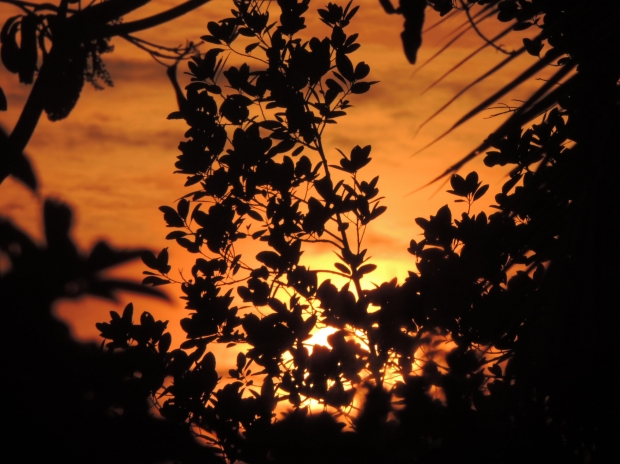
evening
Don Culwell

It’s evening now, and this time of year the melodious up and down buzz of locusts fills the air in my neighborhood…must be a hundred of those large, nearly 2 inch long, fat, green insects rubbing their legs as if they are bows on fiddles…the orchestral piece is stunning! Can you hear it in the trees outside…the buzz up and down the musical scale, on and on?

The purr of the hummingbird wings (90 beats or more per second) as the tiny feathered friend with its throat decked out in ruby red scarf…then in zips an angry hummer intruder, fast, with its whirring, purring hum as it darts after the one feeding on the red sugar water that hangs on my porch. Now both hummers have quickly darted off, only to have one of them return shortly. Can you hear those beating wings with an occasional “chip, chip” of its tiny voice?

Then out back from the deep woods comes the raucous call of the pileated woodpecker…I can see it in the tree as it flies near me, its large red crest standing as if it is all butched…its raucous call breaks the silence of the morning as the sun rises and the day slowly reaches full speed.

Or maybe you are sitting at the base of a large oak soaking up all the nature around you in the cool of the day. Hear the wind in the trees…the pines over there almost seem to whistle so softly in the breeze…leaves of the red maple twitch and turn a bit.

Not uncommonly this time of year a silent moment reveals the pelting of tiny bits of insect droppings from vast armies of walking sticks, caterpillars, or some other ravenous insects as they defoliate the trees…droppings resounding on the brown leaves of the forest floor like so much sleet in the winter woods.

Many are the sounds, some so quiet and soft, almost unnoticed (not the crashing, thunderous storm)… quiet moments, sweet songs, a scampering here and there, the snort of a doe warning her fawn…check out the biodiversity as Hank Lentfer so ably puts it, “The Earth’s rich mosaic of life has a complex and gorgeous voice.” (hanklentfer.com)

Perseid Meteor Shower

BE ON THE LOOKOUT: PERSEIDES METEOR SHOWERS

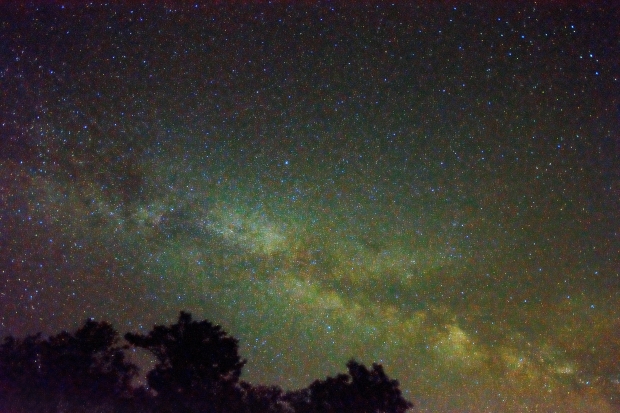
Milky WayNature lovers, look up to see the 2015 Perseid meteor shower…it’s supposed to be at its peak on the mornings of Aug. 11, 12, 13, and 14…perfect viewing conditions, too, as the moon will be dark. Estimates run from 50 to 100 meteors per hour. Meteors will originate in the constellation Perseus in the northeastern sky, but can appear all over the sky, going in all directions.

Evening hours might yield those long glowing eye-popping memorable streakers, while early pre-dawn hours will probably produce the most numbers. It would be a great time to sleep outdoors, or to have a star party…

Here are some tips to get the most out of your meteor shower-watching experience:
• Find an open location away from light pollution.
• Be comfortable…sit or lie down…fill your entire peripheral vision with the night sky.
• Give your eyes time to adjust to the darkness, which can take up to 20 minutes and be disrupted by looking at a bright phone or tablet screen. If you need a flashlight, use a red filter.
• Be patient. Give yourself anywhere between 30 minutes and an hour.
• No need for telescopes or binoculars, which will make it harder for you to see meteors since they only cover a small sky portion.

Night Songs

SATURDAY, AUGUST 15, 2015

Night SkyFor our Third-Saturday August session at South Fork Nature Center, how about a crepuscular nature walk and a nocturnal listening session? It’s a cool way to keep cool during Dog Days!
Meet in front of the cabin at 7:00 p.m. Saturday, August 15. The gate will be open so you can drive to it. Bob and Joyce Hartmann will lead the group in a sunset nature walk, see the new milkweed plants that will help foster monarch butterflies, and the operating sawmill that uses timber from the grounds for projects on site.

Listen for twilight and night songs: learn about what you hear, who makes the sounds, and how they make them. Katydids, crickets, cicadas, long-horned grasshoppers, screech owls, barn owls, great-horned owls, barred owls, coyotes, frogs and toads…Arkansas country is not a quiet place!

To culminate the evening, enter the cabin lit only by kerosene lanterns, to experience what it was like in the Ozarks 100 years ago. Learn more about Almeda Riddle, one of eight children who was raised in the cabin, and whose spirit still lives on in her folk songs. Listen to her sing some of those songs while you sit inside her cabin.

Remember, there is no electricity or water…it’s a Nature Center. Things you might want to bring include a thermos of ice water or other cold beverage; a flashlight (and if it is a red light, or covered with red cellophane, so much the better to protect your night vision); a walking stick; and your favorite portable lawn chair to sit around the campfire.

Come on out August 15th, put aside your wi-fi, and get a strong connection with nature!

Look for the gate on Bachelor Road in Choctaw.

Click here for easy driving directions to South Fork Nature Center…

Butterflies in June

Don Culwell
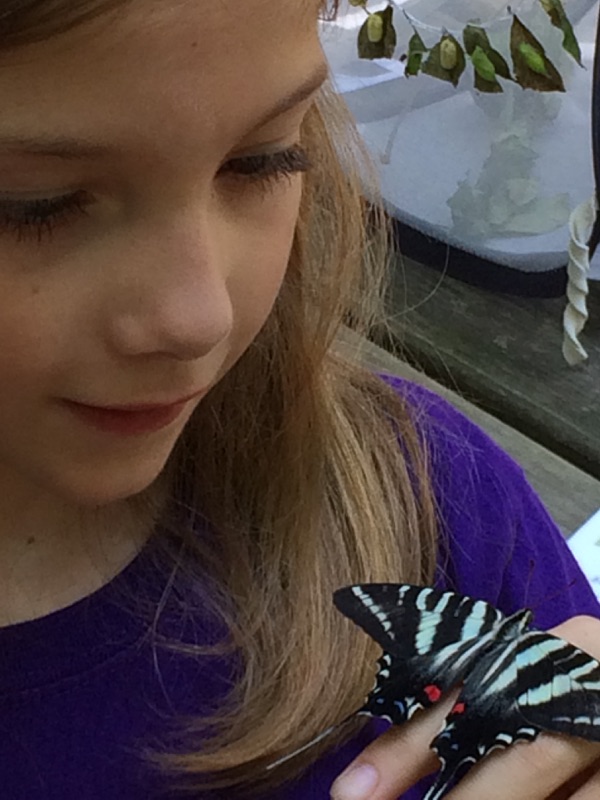
Did you miss it on June 20? As Ruth Andre was setting up for her morning program to talk about and show off her butterflies, low and behold, one of the chrysalis stages of the butterfly she had brought began to crack open and move a bit. YES, out from its chrysalis emerged a zebra swallowtail, wings all crinkled up on its back. But, we watched carefully as its wings unfolded, slowly, into the beautiful black and white zebra pattern with long tails, each with a large red spot. And this beauty hung around quite a while drying its wings as it hung upside down in the sun before fluttering lazily ascending into the morning air.

During her presentation Ruth asked for a couple volunteer kids who anxiously stood up…and they became butterflies as Ruth had them think what anatomical features a butterfly had…how did each feature function? Soon each volunteer was outfitted with 6 legs, antennae, wings, and a coiled, sucking tongue.

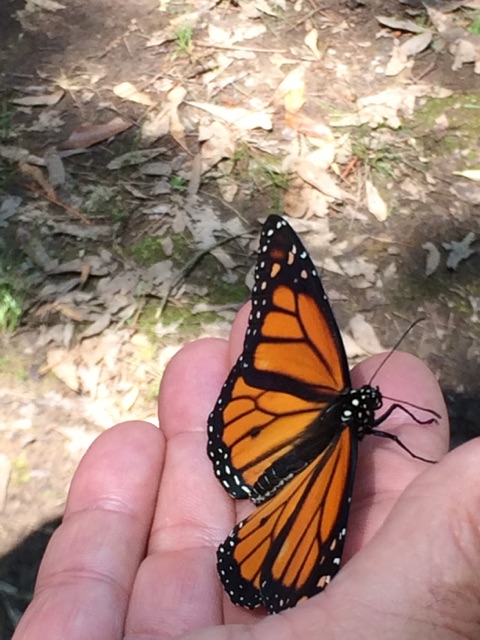
During the morning, a monarch, too, emerged from its chrysalis. Many monarchs that had recently emerged at Ruth’s home had been kept cold in the refrigerator. Ruth passed these out to folks who opened the wax paper packet allowing each butterfly to walk about on your hand, stretch its wings, and then flutter off.

If you missed this exciting day at South Fork, why not plan to be present next June when Ruth returns for another treat with her butterfly friends…see you there!

400 Milkweeds…Grow Baby Grow!

Don Culwell


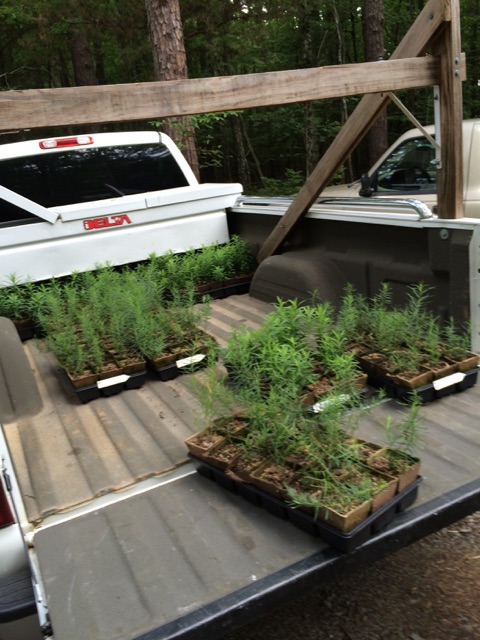
In 4″ peat pots, many with emergent roots, 400 healthy plants arrived at South Fork Nature Center ready for their home in the glades. Nearly half were Asclepias tuberosa (orange butterfly milkweed), A. verticillata (white whorled milkweed) filling in most of the rest of the flats of young plants. And with growth of 6-8″ from seeds that Mary Ann King of Pine Ridge Gardens had planted late in the winter, these plants were ready for setting out in the rich glade soil, where many cedars and a few hardwoods had recently been removed. (Several plants of A. hirtella (tall green milkweed), A. amplexicualis (curly milkweed), A. viridiflora (green-flower milkweed), and A. purpurascens (purple milkweed) were also planted in the glade in small numbers due to poor seed germination.) Spring rains and unseasonably cool weather had not favored rapid growth until May which allowed for healthy plants to be set into the glades in late June. Is it possible that this year of unusual weather will be favorable with scattered days of rain and temperatures a bit cooler?

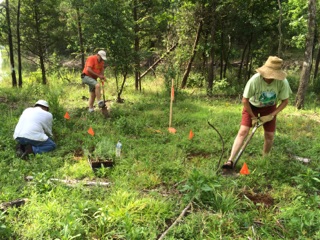
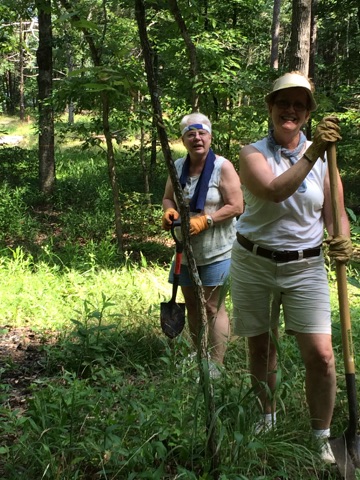
Master Gardeners in the area had been alerted of the milkweed project last fall (as had South Fork personnel); a few calls and e-mails brought folks on three days to do the planting (9 Master Gardeners and 11 South Fork folks); the job was completed in three mornings. Spade the hole, trim off the top edge of the peat pot to prevent wicking up of soil moisture, set the plant and pat in the surrounding soil, mulch with pine needles, mark each plant with an orange flag for easy location (hopefully not by some grazing deer, rabbit, or hungry, grub seeking armadillo) water with a quart cup…and 400 milkweed plants were in.

Barring sufficient summer rainfall, the 23 populations planted in the three South Fork glades will get water by teams using 5 gallon buckets on a wagon or backpack sprayer tanks that can deliver the artificial rain…practice has already shown that 400 plants can be watered one quart each in three hours.

Come on, you monarchs! Your table is set for egg laying and feasting!

This project is part of a nationwide program to enhance monarch habitat, since their numbers have diminished greatly in recent years. The SFNC grant is through the US Fish and Wildlife Service which paid for seed and plant care producing the plants.

Why not come to South Fork and see the plant populations for yourself? The trails are always open beginning at the kiosk beside the iron gate…adjacent parking is available.

Click here for easy directions