Ferncliff Fall Wildflowers

Culwell Wildflowers Ferncliff

Ferncliff Camp and Conference Center just west of Little Rock was the site on Saturday and Sunday, September 21, 22, for a study of wildflowers that could be seen along creeks, lakes or in more moist habitats this fall season. The class used hand lenses and forceps to see the flower parts and discussed their functions as class sessions were held inside around tables, outside at benches, or walking the environment around the lake.

Students learned the mechanism of using a dichotomous key as a few wildflower families were identified. “What is this flower?” was a common question and a number of names were tossed around, both common and scientific.

The importance and mechanisms of pollination and fertilization as it affects species were noted; the video “Sexual Encounters of the Floral Kind” exemplified these life processes for angiosperms, the world of flowering plants.

The class taught by Don Culwell was one of four natural history workshops offered annually by Arkansas Audubon.

Don Culwell

Home Schoolers of Faulkner County

by Don Culwell

They were here, all 15 of them (elementary, middle school, and high school students) and anxious to learn about South Fork and the ecosystems at South Fork the afternoon of September 13. Docents Steve Smith, Larry Bintliff, Jim Solomon, and Don Culwell were on hand. Class outdoors in nature’s classroom lets one see “where the rubber hits the road.” Indoor learning allows time for “book appreciation,” some memory work, and understanding of principles. Outside there can be discussion putting into practice what one learns indoors…SEEING how the puzzle fits together. And so it was!

Walks along the trails led groups to a moist, seep area where colorful orange and red Touch-me-not flowers grew up to four feet high in moist soil of the seep area. Their fat fruits with ripe seeds inside “squirmed” and threw their mature seeds when the pod was touched (thus its name)…it surely startled the student holding a ripe fruit in his hands!

Garden spiders: two-inch large animals on eight, long legs with a big, rounded abdomen bearing bright yellow markings…attractive and making a web with one, large, white, zigzag thread (like a lightning strike) of silk across the middle.

Then there was the rock-hard gall found lying on the ground that, when cut open using a knife, revealed a small, greenish, larva that would have chewed its way out of the gall, probably a gall off of some oak leaf in the forest…the larva that would become some mature insect.

Back at the Riddle Cabin in the shade of the tall trees, classes discussed just what a tree was: a trunk that conducts water up from the roots underground up to the leaves high up in the canopy; leaves that contain countless chemical factories using the water, carbon dioxide from the air, and sunlight falling on molecules of leaf chlorophyll that absorb the light energy to fuel chemical reactions (photosynthesis); trees that make flowers and fruits to grow more trees, trees that provide food and home for animals that eat the seeds. THE FOREST IS INDEED ALIVE!!

Sept. 21: “Animal Skulls…Frogs & Toads”

by Bob Verboon
Come join Master Naturalists Bob Verboon and Tom Krohn at South Fork Nature Center Saturday, September 21st., from 9:00 a.m. to 11:00 a.m.

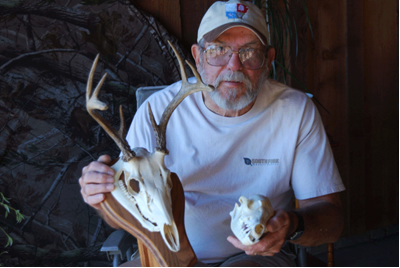
Learn from Bob Verboon how different animals might have survived in their natural habitat by just observing their skulls.

Can you see the major differences in these two skulls? How about similarities? Do you know which one is the carnivore and which is the herbivore? Can you tell which one is the predator and which one is the prey? Can you tell if they were healthy or sick? Can you tell how old they were when they died?

Listen to Tom Krohn and learn to identify several of the frogs and toads in our area by their calls.

SFNC Docent Bob Verboon

Frogs and toads have been around for a long time. They reproduce in water and develop into land animals today much like their ancient ancestors did. Their remarkable adaptations and survival tactics continue to amaze scientists through the ages. Who hasn’t captured tadpoles and watched them grow in a man-made pond where they lose their tails as they form legs to allow them to walk up onto shore? Many frogs and toads are so small that they are not readily visible but can certainly be recognized by the sounds they make.

naturalist Tom Krohn
Naturalist Tom Krohn

Come to South Fork on Saturday, September 21st., Master Naturalist and FrogWatch Coordinator Tom Krohn will have you answering the calls around your pond.”

“Where Does Your Water Shed?”

Don Richardson

Saturday, July 20th, was the third Saturday-of-the-month nature activity at South Fork, where Don Richardson and Ed Wood led a walk and discussed how important it is to be aware of the watershed you live in and how your lifestyle can affect it.

Don Richardson, South Fork Nature Center

We ALL live in a watershed. You might not be able to see a lake, river or ocean from your home, but the land you live on does shed water. We talked about the watersheds that the participants came from. Some were from the South Fork of the Little Red River watershed and some were from the Cadron Creek watershed. Each participant received a pamphlet with suggestions of things they as individuals can do in their own watershed. At the end of the walk, we discussed the priorities of the local Conservation District over the next year concentrating on the South Fork of the Little Red River.

Halberg Ecology Camp Students

halberg
Audubon’s Halberg Ecology Camp Students Visit South Fork
By Don Culwell

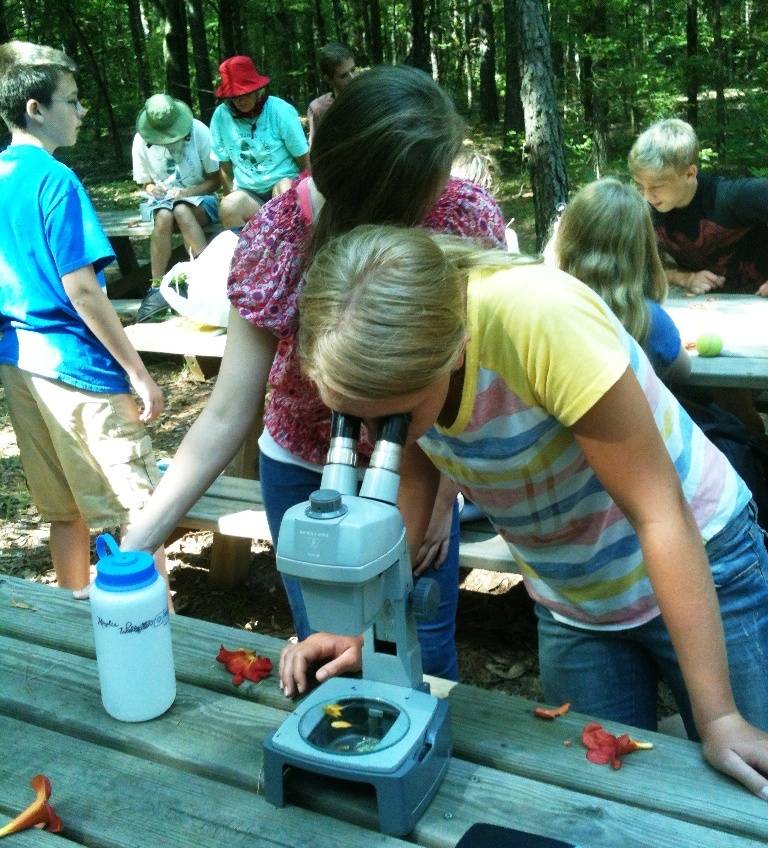
Saturday, July 6, twelve ecology students who were spending the week at Mount Eagle Camp northeast of Clinton, spent the morning at South Fork. The picnic tables outside the old log cabin (where two marker boards were placed for drawings and notes) was the place where students dissected flowers using dissection microscopes as they discussed the sexual system of a flowering plant and how the flower is adapted for the reproduction process. Sperm nuclei from the pollen tube unite with the egg nucleus in the ovule to make a zygote that divides many times (mitosis) forming the embryo that becomes the seed…meiosis (the reductional division occurring in the sex organs) had formed the cells that made pollen grains as well as the cell that became the egg in the ovule. Fruit and seed dispersal play an important role in maintaining the species.

Following the discussion of floral, fruit and seed structures, the group hiked the trail along the edge of the peninsula making observations of plant life there (trees, shrubs, flowers, mosses, fungi and lichens).

Earlier in the morning the class had visited the SFNC Herbarium downtown in Clinton at the GRF Office where they learned about the importance of herbarium specimens in research and how they are prepared…the SFNC Herbarium collection contains about 850 specimens representing all the species known to exist on the grounds at South Fork.

These ecology students (high school freshmen) were attending their third year of camp sponsored by AR Audubon; students attended the Camp by invitation only based on their participation the previous two years. They were under the direction of Robin Buff who had designed the week and led exercises in line transect analysis in the woods, processing of plant specimens for the herbarium, studying ecology while floating on the Buffalo River, and a day spent at Blanchard Caverns studying cave life and formation.

Even as dry as it has been, there were still several nickel-sized May apple fruits on stems where the leaves were all dried up in populations where the clones existed.

A Florida Sea Shore or Not

Not….considerable fresh water from Greers Ferry Lake laps up on the banks of the peninsula at South Fork, but this is an Arkansas lake shore and not the ocean. A Florida sea shore is much different.

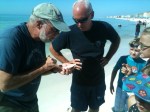
Don Culwell has spent considerable time walking in the surf of the white sand beach around Destin, Florida and he has boxes of beach wrack (shells, mermaid purses, seeds, sand dollars, etc.) that washed up on the beach by action of the tide. This evidence of ocean life tells about yet another ecosystem that is found after a long day’s drive south of Arkansas down on the shore of the Gulf of Mexico.

Don Culwell

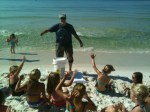
Highlights from “The Living Beach” biology class:

  • Mermaid purses: square, black, inflated skate egg cases with a hook on each corner…each purse just had a skate break out and swim away…hundreds of these lie at the high tide line among the washed up Sargassum brown algae, marine worm tubes and shell wrack…

  • Blue crabs, speckled crabs, hermit crabs, ghost crabs…

  • Coquina clams, small, pink, yellow, or cream colored bivalves we see burrow down into the wet sand (a major source of food in the tidal ecosystem), Venus clams of several sorts…

  • Sand dollars all broken into pieces, but one can see “petals” on the tops of the pieces where hair-like tube feet once projected to take in oxygen while other tube feet moved food particles to the mouth opening below…

  • Gastropod shells, thick and strong, are all broken where some hungry crab used its powerful claws to crack into the hard shell for a soft bodied gastropod lunch…