April Nature Center Tour

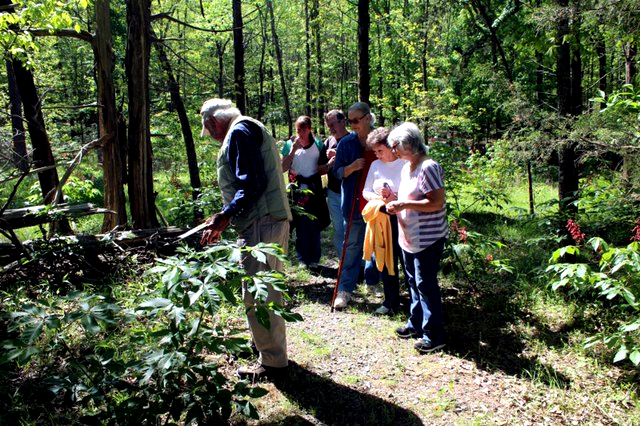
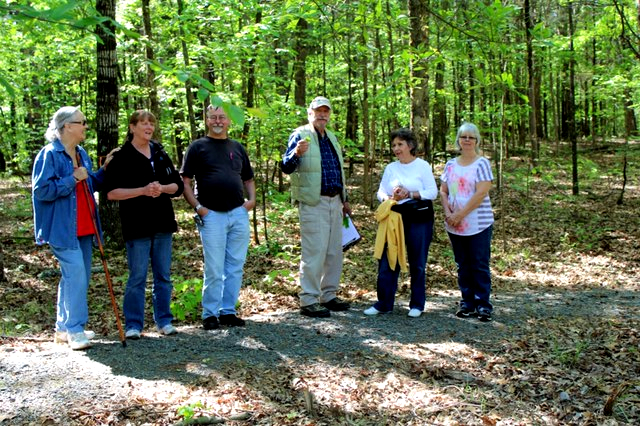
The 3rd Saturday group tour season had its inaugural event on April 23. The party (including a four-legged sidekick) met up at historic Riddle Cabin and took the peninsula trail, led by docents Bob & Joyce Hartmann.

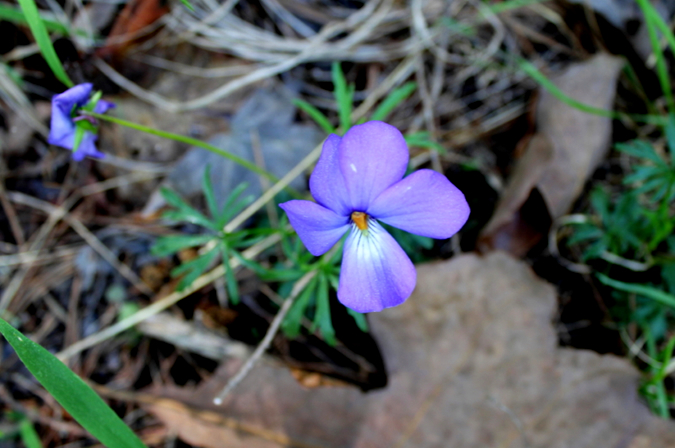
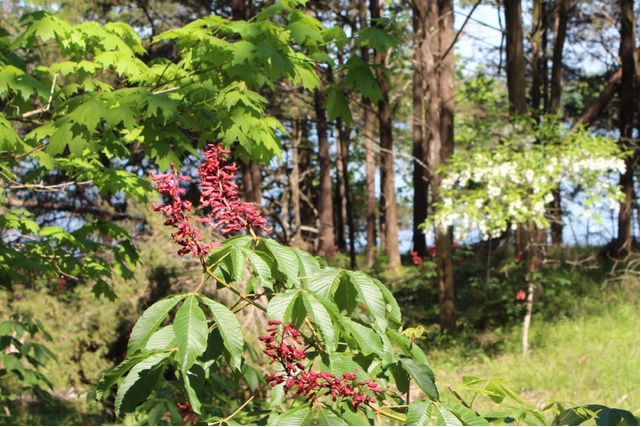
The sunny afternoon offered open season on spring bloom identification, bird watching, etc. Red Buckeyes and Fringe Trees stole the spotlight, while Spring Beauties, Birdfoot Violets, Buttercups, and Rue Anemones populated the wildflower parade. Red-eyed Vireos, Tufted Titmice, and Pileated Woodpeckers ruled the branches for the morning.

Back at the cabin, a relaxed painting workshop drew the program to an pleasant close. We are ALWAYS happy to share the delights of our beautiful lakeside trails in fellowship with other artists, teachers, and nature lovers in general! The park is open year-round, but please make plans to join us for an upcoming 3rd Saturday group walk.

Awesome Trail Markers

The entire length of the two-mile trail system on Greers Ferry Lake is marked with informational signs like these. Catch them all on your next visit!


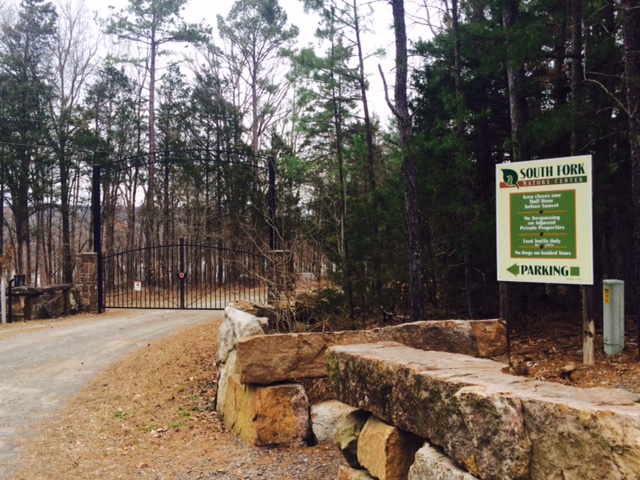
The Trailhead Gate is located on Bachelor Road off Hwy 330: GPS Coordinates Latitude 35°33’25.54″N Longitude 92°23’3.66″W
South Fork Nature Center Greers Ferry Lake AR - Front Gate

New Weather Station at South Fork

Marc Hirrel, Docent

2016 marks a new beginning at SFNC with the installation of a weather station in one of the milkweed plots east of the cabin. This site was chosen over the cabin because the station will monitor soil temperature at a six inch depth. Data collected at this site will help to correlate spring green-up and flowering of our milkweeds with both soil and air temperature along with rainfall.

We could just rely on the internet weather sites such as Weather Underground maintained by the Weather Channel (http://www.wunderground.com/). Such sites compile data from hundreds of locations across the country and the world. For us at South Fork, we could use data from nearby reporting stations in Clinton and Heber Springs. Even though Clinton is only 5 miles from us, our weather can be quite different. Greers Ferry Lake influences the weather on our peninsula, especially rainfall. This past year, rainfall monitored at the milkweed plots showed an inch more rain for the eastern plots compared to the western plot. Thus, the importance of on-site monitoring.

The instrumentation consists of two data acquisition units. One tracks daily maximum and minimum soil and air temperature for six days. The other is a tipping bucket rain gauge that stores rainfall for nine days. The units are housed in a weather proof plastic box that provides easy access to each unit. Both instruments were inexpensive with a combined cost of under $100.

Below is a summary of weather for two reporting periods in 2016. As one would expect the soil temperatures never got below 32F and variation was less than 10 degrees. By comparison air temperatures varied 30-40 degrees. There were 9 out of 11 days with minimum air temperatures below 32F.

  AIR TEMPERATURE (F) SOIL TEMPERATURE (F) RAINFALL (in.)
Jan 8-13 Max Min Max Min Cumulative Total
Range 68.9-39.5 37.3-16.3 49.0-44.2 47.9-42.1 0.74
Jan 15-19          
Range 73.3-35.2 43.7-19.6 48.1-41.4 45.4-41.3 0.78

Because the units can store only a limited amount of data and opportunities to retrieve it, there will be gaps in the data. In the near future, there will be a training session for docents to learn how to retrieve and record the data, so gaps in the data will be minimal.

“Red Lanterns” by Marc Hirrel

Marc C. Hirrel, Leopold Education Project

Autumn is the season of the hunter. A good time to venture through the woods of South Fork. Look for red lanterns as you make your way through the yellows, tans, and browns of changing oaks and hickories. Let the red lanterns mark your path.
Red lanterns, to Aldo Leopold in A Sand County Almanac, were blackberry leaves lit by the October sun to mark his trail. Hunting was how he made connections to the land. And those connections was how he read the landscape and crafted a personal ethic on “how to live on a piece of land without spoiling it”, which was Leopold’s conservation cornerstone. And it began with a grouse hunt. In his essay Red Lanterns he is challenged to read the landscape connecting the brambled habitat and the clucking grouse in cover with the dog having analyzed thousands of smells then hitting olfactory gold and going to point.

In Smoky Gold, Leopold challenges us to read the landscape by going on our own hunt. The sweetest hunts are stolen. To steal a hunt, either go far into the wilderness where no one has been, or else find some undiscovered place under everybody’s nose…..like South Fork.

This November go steal a hunt by following the red lanterns of SFNC, like:

red-lanterns-leo-sfnc2

What did you find? What did you read from the landscape to help your hunt? Did those red lanterns help you to return to the trail?

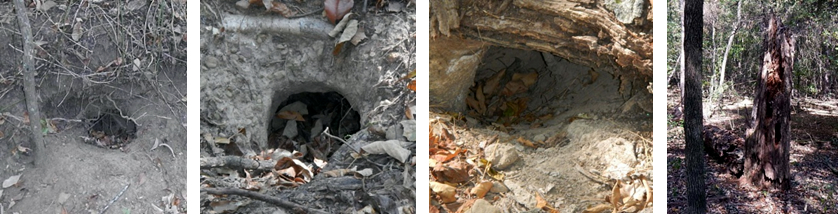
My hunt lead me to these dens and to some questions. Whose den is it? What makes this location so special? Next month we’ll see what my game cameras reveal and what I read from the landscape.

burrows

Gallery: Oct. 13 Cooking Workshop

Great fun and interesting cooking techniques were on tap for the “Five-Star Dining around a 100 Year Old Cabin” event held at South Fork Nature Center on October 13, 2015.

Docent, Krissi Graham and Clinton’s Extension Homemaker’s president, Wendy Russ, worked hard to gather supplies and organize the event. Over 20 people participated in the evening’s program. The menu consisted of vegetables steamed in Kudsu leaves sewn together to make a cooking pouch, chicken or fish cooked on woven- reed (Yucca privet, Russian Olive and Muscadine vine) mats and baskets over hot coals, pine needle tea and Kudzu Lemonade.

One young family with two small children took a hike before dinner collecting pine needles while groups of participants divided up and started creating the sewn leaf packets, vine cooking baskets and woven mats.

Another group of participants mixed the ingredients for peach cobbler and poured it into the waiting Dutch Ovens. The ovens were placed in the fire ring and banked with hot coals. Approximately 1 and ½ hours later the evening’s activities wrapped up as the group devoured the delectable dessert! As darkness fell the last of the food packets were removed from the coals, a lantern was lit and stories started surfacing about “when we use to camp……” etc.

The evening was a great success. Primitive cooking techniques, using homesteader tools (and a little foil), were explored and fun was had by all!