“The Haunted Cabin”

by Krissi Graham
Krissi Graham CHS at South Fork
The Clinton High School Environmental Club chalked up a ‘frightening’ good success at our October 18 “Haunted Cabin” event. Forty five visitors were entertained with live music by the Will Shannon and Jake Trogden duet.

Campfire
Jennifer Lovell and Tyler Robinson chopped, cooked, prepped, and fed the group foil packs. Bailey Henry and Faith Scott added Dutch Oven Cobblers to the campfire cuisine. We enjoyed an easy clean-up because there were no crumbs or leftovers to be found.

Fun at the Nature Center
Alahna Martin led a meaningful devotion at one of the scenic circular gathering sites.

Students Osmar Carrizales, Shayla Ross, Colton Cook, Serena Jones, Myra Hawes, Dax Helmendollar, Jeremiah Crabtree and Marissa Kipfer were led by Tiffany Burns in scheming up spine tingling ‘Terror-on-the-Trail’.

Halloween at South Fork Nature Center
The haunted hike was prefaced with the story-telling talents of Dalton James. Hopefully, the SFNC neighbors interpreted the screams they heard as youthful squeals of delight. (From where I sat at the campfire their emotional cries seemed to echo impending doom across the lake.)

Geocaching at South Fork Nature Center
Using the latest geocaching technology several guests experienced success with their first attempts at finding buried treasure thanks to Donovan Turner and Austin Decker.

CHS Environmental Club at South Fork
Our Nature experience was both a welcome respite from the demands of a materialistic culture and a glowing tribute to our students in roles of leadership. I greatly appreciate the help from adults Marc Hirrel, Melvin Browning, Sandi Jones, and Chris Graham.

“Bones and Skulls” at SFNC

VERBOON PRESENT HANDS-ON PROGRAM ABOUT BONES AND SKULLS AT SOUTH FORK NATURE CENTER
by Joyce Hartmann

About 25 people assembled at the 100-year-old restored cabin at South Fork Nature Center September 20th to learn about bones and skulls they might find in the woods.

Bob Verboon at South Fork Nature Center
Bob Verboon provided dozens of skulls, bones, and mounted animals for those attending his Saturday session at South Fork Nature Center.

Docent Bob Verboon, who is also a Master Naturalist and skilled taxidermist, brought dozens of specimens to provide hands-on learning. After a short time, people were able to identify many skulls, and to know whether it was a predator or prey. They also learned how to age a deer by its teeth, and judge whether the animal was a carnivore, herbivore, or omnivore.

Participants tried to match up the skulls displayed on the table with pictures of the animals portrayed on the easel. Everyone found out it was a lot more difficult to do than it looked!

Animal Skulls at the Nature Center

Teaching about Animal Bones
Children enjoyed being able to look closely at skulls to decide what kind of animal they had once been.

Afterwards Docents Janet Miron and Don Culwell led the group on a nature hike on trails around the wooded peninsula. Throughout the morning Docent Kay Verboon demonstrated Dutch oven cooking, making delicious blueberry and peach cobblers that outdoor participants enjoyed after their walk.

Just a reminder…the trails are open to the public for hiking every day, but on the third Saturday of each month, the gate is open for the public to drive to the cabin and enjoy special programs there. Also, educators can schedule special field trips to help studies of ecosystems, habitats, structure and function of plants, abiotic and biotic factors of an ecosystem, environmental adaptions of plants and animals, the natural divisions of Arkansas, or many more areas of nature. Twenty-four docents are available to teach nearly any topic in the outdoor learning laboratory.

Winter Birds of Convenience & Purpose

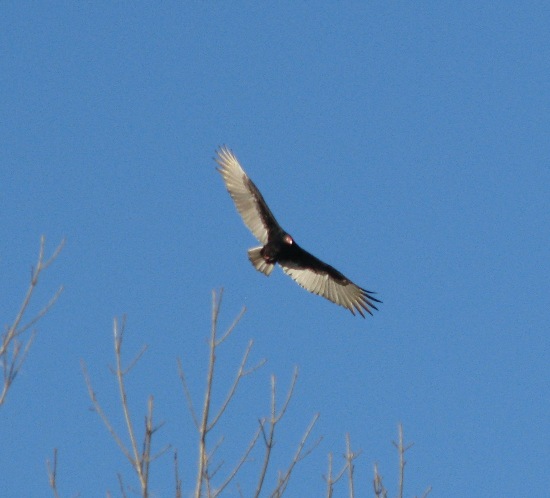
South Fork - Turkey Vultures

If you were to visit the South Fork Nature Center area this time of year specifically to see local bird life, you might be somewhat disappointed. Birds are sometimes difficult to find in the winter woods.

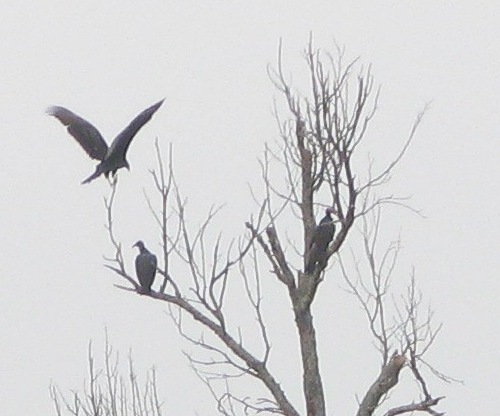
But do not despair; two kinds of large all-black birds can frequently be seen cruising just above the treetops or soaring high in the sky – those circling black specks way up there. These birds usually are either Turkey Vultures or Black Vultures, or both. They have large black wings which in flight are spread on a dihedral, putting the wings slightly above the bird’s body with wing tips held up at a slight angle. Their wings are built for soaring and gliding to take advantage of thermal columns of rising air to gain high altitudes with little or no wing-pumping effort.

Turkey vulture

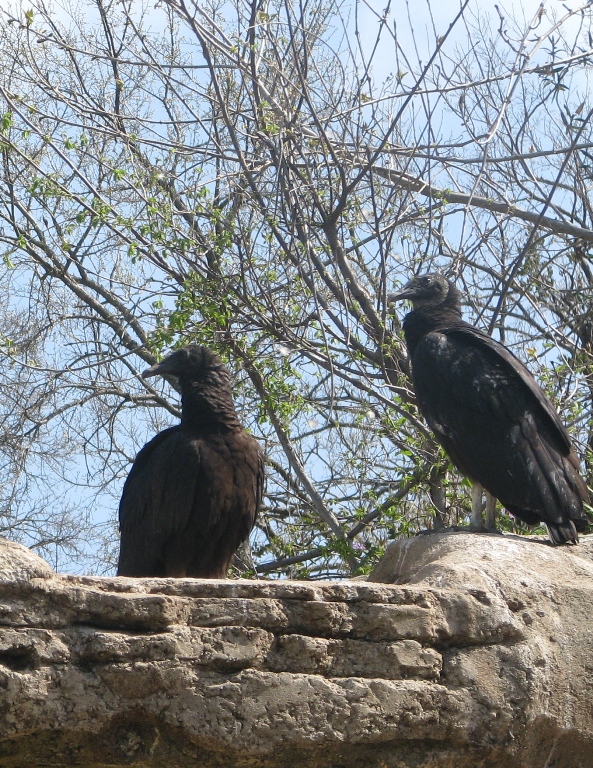
The Turkey Vulture has long tail feathers extending well beyond its body and a featherless red wrinkled-skin head, built for moisture control during feeding, while the Black Vulture has stubby, short tail feathers, easily seen when in flight, and also a featherless head but with black wrinkled skin. These features make identification of these similar birds quick and
easy.

South Fork Nature Center - Black Vultures

The Turkey Vulture is extremely proficient at detecting dead things by smell; their olfactory system is so highly developed that they can recognize odors while soaring on those upward flowing air columns hundreds of feet high. From up there they scout for food, specifically dead, decomposing creatures. Even though Turkey Vultures’ eye sight from on high is not that
great they are usually the first to arrive at an undiscovered feast – frequently soon to be followed by groups of Black Vultures with an attitude.

Evidence of beneficial carrion removal at SFNC by vultures includes hollowed-out armadillo carcasses, poached deer parts and partial fish remains along cove shorelines. Frequently you may encounter vultures consuming a road kill and occasionally a dead vulture who had become a highway glutton unable to fly and avoid traffic.

We owe both vulture species a deep debt of gratitude for the speed and thoroughness by which they dispose of carrion reducing the likelihood of related disease in the wild.

Glade Restoration Progress

by docent Bob Hartmann

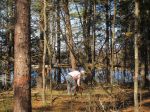
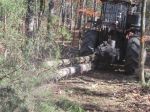
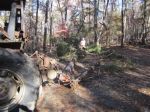
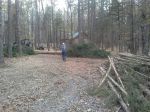
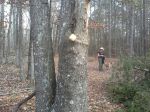
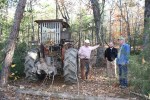
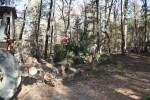
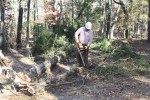
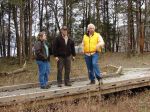
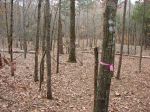
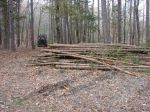
Project work began in mid November with Eastern Red Cedar removal from the first (the Seep Area) of three selected glade areas. All unmarked cedar is being cut at their base and removed. Trees marked with orange tape are being left in place. Downed trees are hauled out to adjacent road and parking area edges where topping, trimming and log separation is performed and for temporary storage.

In the last photo is an unusual, very edible ‘Lion’s Mane’ mushroom in prime plucking condition – but it wasn’t, only photographed!

Larger tops are to be moved to Corps of Engineer assigned drop-off sites to be used for fish habitat and attractor construction. Logs of fence and construction value will be relocated on property for future use. Trimmings will ultimately be burned in the roadway/parking area or moved to a suitable nearby burn site. Work on the second Glade site is underway.

Nature Center Maintenance Update

The Nature Center will reopen on Tuesday, January 7th, 2014. We apologize for any inconvenience the closure may have caused. Additional Glade Restoration work will be scheduled in the near future.

Take a look at the work in progress!