The late Mrs. Riddle was a renowned folk singer & local historian. She was born in the cabin that is now part of a historic reconstruction on our site.
Docent Appreciation Night

By Don Culwell
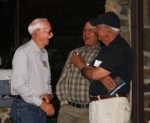
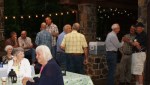
With a welcomed break in the weather (the rain was gone and a colorful sunset shone out over the bay through the trees past Janet and Philip Miron’s deck), the pleasant environment and the cool evening air set the stage for a fine evening at South Fork. The group was entertained by Jerry Manion and his string band that was dubbed The South Fork Nature Boys…their soft tunes and verse were obviously a big hit among the docents and spouses as the evening progressed…the dusk was lighted by strings of lights and numerous pot candles.

Dinner for the evening was provided by the Gates Rogers Foundation Board members (Janet’s tasty smoked pork and grilled chicken made a hit along with all the other fine dishes). Dinner plates piled with good food were carried to the pool table in the game room or out on the deck where music could be enjoyed.

GRF Board Chair, Don Richardson, welcomed the honorees of the evening (the South Fork docents) and Don Culwell, Programs and Services Committee Chair, thanked all docents for their exceptional and enthusiastic leadership with both class groups of students who spend the day at South Fork and the numerous weekend activities that are led by the docents. As a “Thank You,” docents were each given special T-shirts inscribed with SFNC and either “Advice from a Tree,” “Advice from a River,” or “Advice from a Lake.” He noted that “The grandeur of South Fork would not exist without the enthusiastic docents and their presentations for the public…THANK YOU SO MUCH!”

The evening concluded in the candlelight with music from the stringed instruments of the “South Fork Nature Boys”……Jim Solomon and Verniece Harness and Bob and Joyce Hartmann were even seen to dance a few steps on the planks of the deck…the evening on the bay beside South Fork had been another fine one!

Docent Training, May 18

By Don Culwell
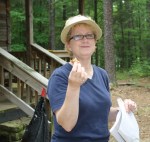
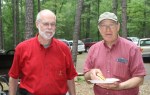
On Saturday afternoon, May 18, South Fork docents who lead a wide variety of activities at SFNC along the trails and at the old log cabin spent time sharing information about flowers, fungi, insects, and such life as is found at the Nature Center. After a lunch of burgers and dogs fresh off the grill the folks that had gathered reveiwed aspects of leading groups like they do at SF by using the SF Docent manual as an informative guideline.
Materials stored in the cabin for use by the docents were examined…these will facilitate their work leading classes and groups coming to South Fork: identification manuals for plants and animals, jars of dry fruits and various skeletons, slice-sections of tree wood, 2 large marker boards, clip boards and pencils, firewood for the old iron stove, first aid kit, name badges, water bottles, bottles of hand sanitizier, a copy of the Master Plan for SFNC, binoculars, dissecting microscopes, hand lenses, a Coleman lantern to light up the cabin on rainy days, and such things.
Docents were encouraged to spread the word about activities they lead at SFNC and recruit interested persons and groups that will join them for their specific activities or walks in the woods along the trails.
Nature Celebration Day

By Don Culwell
Saturday, May 4…the day began as the sun peeked through the sky, but clouds began to creep in above as the temperature of the morning hovered around a cool 50 degrees. Hot coffee or hot chocolate with a warm cup in hand felt good and the fire in the old iron stove in the cabin wasn’t half bad either. But the warmth of visiting with neighbors, friends, and docents as people gathered in the cabin or around the picnic tables to enjoy nature once more was not dampened…spirits ran high!
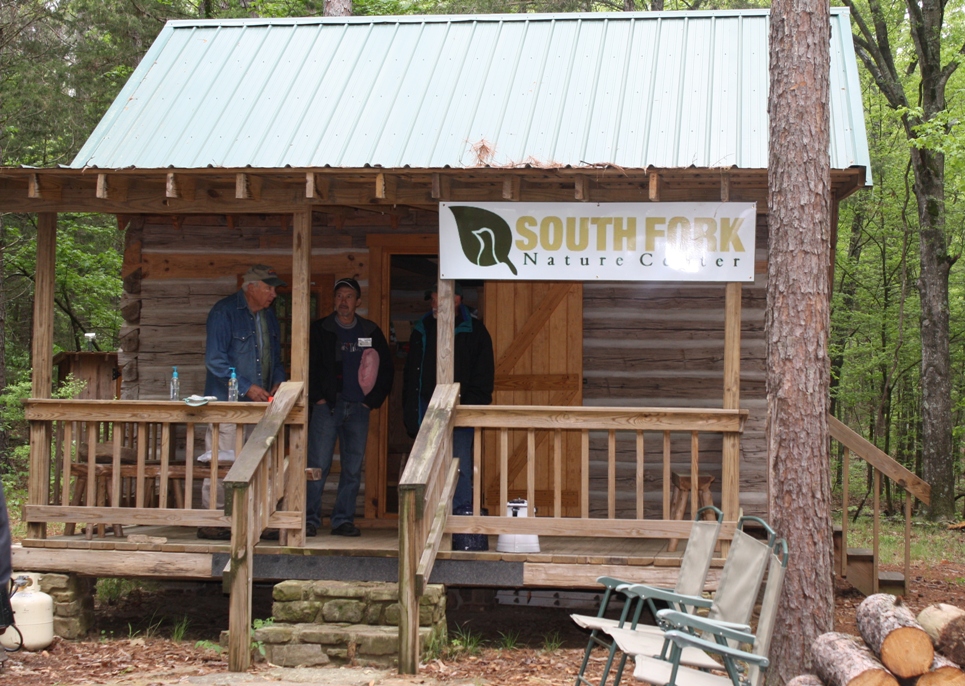
Sure enough, around 10:00 am, in came the group of middle school kids that had called…they were ready for the scavenger hunt and they were not disappointed! Shirley Pratt got them off to their destinations where docents led them in search of life in the ecosystems out over at the waterfall, out on the point, and then deep in the woods. Those of us remaining at the cabin knew when their hunt had ended, for there was whoopin’ and hollerin’ as the gang came bounding back on the trail!
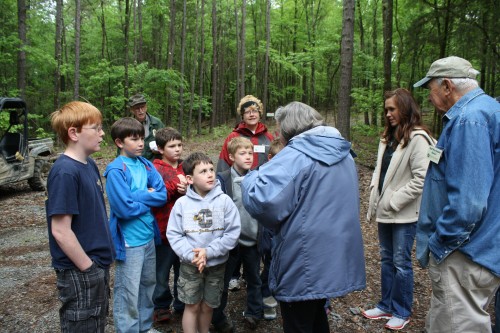

Other visitors during the day got to hear about the plans for South Fork and its activities: building an outdoor classroom with restrooms, one that would accommodate groups of school kids out for an all day learning experience as well as groups that sit at tables to study and enjoy aspects of the out-of-doors (and, of course, putting in a water line from up the hill on Klondike), building an amphitheater into the hillside, and planning for a grant that will restore the ten acres of glade near the bluffs on the peninsula.

Docents took visitors out from the cabin on the trail around the seep and the glade, even in the heavy mist that occasionally hung in the air. Those wanting memberships to South Fork found them, although membership into South Fork is not necessary in order to be a part of activities or walk the trails…when noon arrived, lunch was served for all hungry persons: burgers and dogs fresh off the charcoal grill.

The landscape on the edge of the woods at South Fork was highlighted with the striking red flower clusters, like so many Christmas trees, in the tops of the red buckeye shrubs. Growing low to the ground, only six or eight inches tall was a population of the southern twayblade orchids, a population that is the northern-most in the region; each plant has a stalk bearing only two, small, thumbnail size leaves above which sit a dozen or so tiny, maroon flowers…so very dainty. There must have been forty to fifty plants growing on the slope in the woods beside the cabin…and one had to look hard to see them.

Visitors to South Fork that day had not been in anticipated numbers. But the weather was not what had been “ordered,” either. Yet, the cooler than expected air around us and the cloudy, somewhat drippy weather, were just parts of another day in the life of the woods, a woods that is always vibrant with life and excitement!
It’s too bad you may have missed it!

St. Joseph Sophomores Spend Day At South Fork
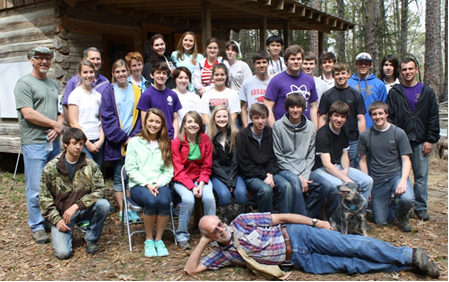
By Dr. Don Culwell
It was Tuesday, April 9, when St. Joe 10th graders, 28 of them, came to South Fork for the day. Their biology teacher, Jim Belote, had just introduced them to plants and animals in the classroom and they were anxious to be out in the woods where they could see, first hand, the ecological relationships of organisms in their environments. Organisms in an ecosystem interact with one another and their environment having some influence on the life around them: trees to trees, environment to trees, animals to animals, trees to animals, animals to environment, etc. The bus arrived at 9:00 AM, unloaded at the front stone entrance, and were welcomed by Don Culwell and Steve Smith. Don spoke of their day’s activities and the program that was planned.

Along the fifteen minute walk on the trail to the Riddle Cabin, several stops were made pointing out different species of trees and the varying bark patterns (very light colored, scaly bark of the White Oak; black, ridged, tight bark of the Red Oak; reddish-brown patches of loose bark on the Shortleaf Pine); Trout Lilies that had recently bloomed (their white petals having already fallen) were showing large fruits on their tall stems that had bent over in the leaves…seeds were developing for the next generation of mottled leaves that would grow above the small, Trout Lily bulbs just below the surface of the soil. Further along, a large pile of huge, scattered chips of light colored wood lay near the base of an old dead tree at the edge of the trail…some Pileated Woodpecker had just made the chips fly as it noisily pecked away in search of insect larvae (the sight of that big, red-crested woodpecker in action would have been some sight to behold)! Along the trail, the tiny, red leaves newly emerged from the buds of the White Oak seedlings caught our attention…the red coloration that, at first glance, resembled some flower, was just red leaf pigmentation that was protecting the new, tender, growing cells of the leaf from the intense radiation of light. Of course, the forest canopy had just begun to sport tiny leaves that soon would form an umbrella over the forest floor cutting out much of the light that the spring flowers below needed for their growth: Mayapples with their umbrella-like leaves and one, single white flower yet to bloom; the white Toothwort flowers atop a six inch stem, in the mustard family; a few purple Violets; and some white petaled Spring Beauty flowers. Heard up in the treetops was the “peter…peter…peter” call of the Tufted Titmouse as it called back and forth to other members of the species in the forest canopy.

Arriving at the log cabin, schedules were checked, three groups were formed, and docents led students out on their walks into the woods (Steve Smith and Larry Bintliff led investigative walks checking out the trees and whatever life could be found while Jim Solomon focused his group of students on insect life along the way).
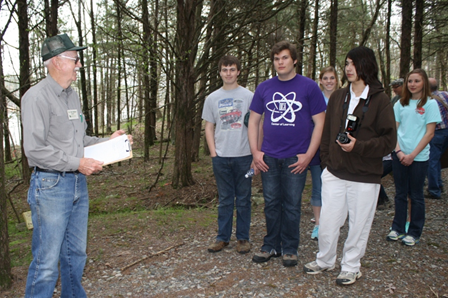
An hour and 15 min. later, three other docents took over the groups for a study of wildflowers and their functions (Don Culwell), food chains and food webs (Janet Miron and Glenda Hall), and an art drawing project featuring tree and leaf structure, texture, and design (Joyce Hartmann).
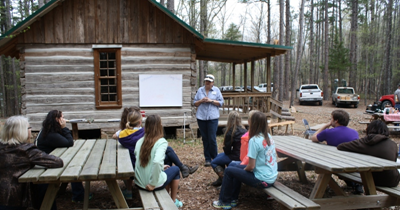
Lunch at the tables outside the cabin was welcomed for a brief rest from the activity of the morning; before long, however, a hike left for the trek over the trails to the waterfall area through another section of South Fork. Water was running down the rock bed of the small creek that drains the surrounding hills…small pools and runoff areas were green from the growth of algae. Now in the spring when the season is more blessed with rain, the pour-off of the waterfall into a channel to the lake was spectacular around the large rocks. This was the place where all students wanted to climb for a better view from all angles of the splashing, rushing water below.
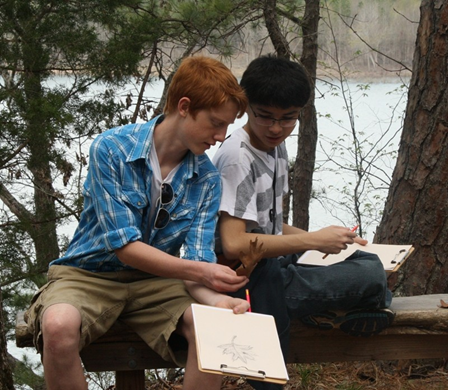
Back at the cabin shortly after 1:30 the class was found doing a quick recap of the day’s activities and the meaning of their encounters. The weather had been grand with the temperature near 80 and sunshine falling through the trees to brighten the forest floor. Good-byes were said as students headed off to board the bus for the school campus in Conway.
Animal Skulls & Habitats
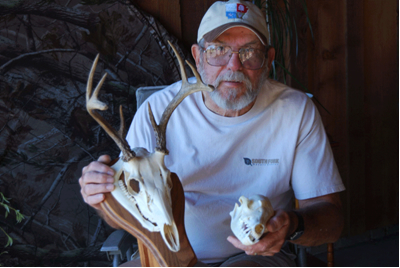
Learn how different animals might have survived in their natural habitat by observing their skulls. Can you see the major differences in these two skulls? How about similarities? Do you know which one is carnivore and which is the herbivore? The predator or the prey?
Framework
- LS.4.5.5 – Examine the role of food, space, water and shelter on the carrying capacity of an ecosystem.
- LS.4.5.14 – Categorize organisms by the function they serve in ecosystems and food webs.
- LS.4.5.15 – Conduct field studies identifying and categorizing organisms in a given area of an ecosystem.
- LS.4.6.1 – Identify environmental conditions that can affect the survival of individual organisms and entire species
- LS.4.8.1 – Analyze the effect of changes in environmental conditions on the survival of organisms and entire species
- BD.2.ES.2 – Describe relationships within a community
- BD.2.ES.9 – Describe how limiting factors affect populations and ecosystems
- EBR.8.B.5 – Population Control Factors in an Ecosystem
 South Fork Nature Center
You must be logged in to post a comment.